Introduction to Fractions
Link
About these worksheets
These worksheets introduce the concept of fractions from the ground up. Activities include naming fractions from words and pictures, writing fractions from visual models, identifying correct fraction representations, partitioning shapes into equal parts, determining whether fractions equal zero, one-half, or one whole, examining fraction values between whole numbers, comparing relative fraction sizes, finding reciprocals, and expressing fractions in words and numbers. Resources span first through fifth grade.
1g3


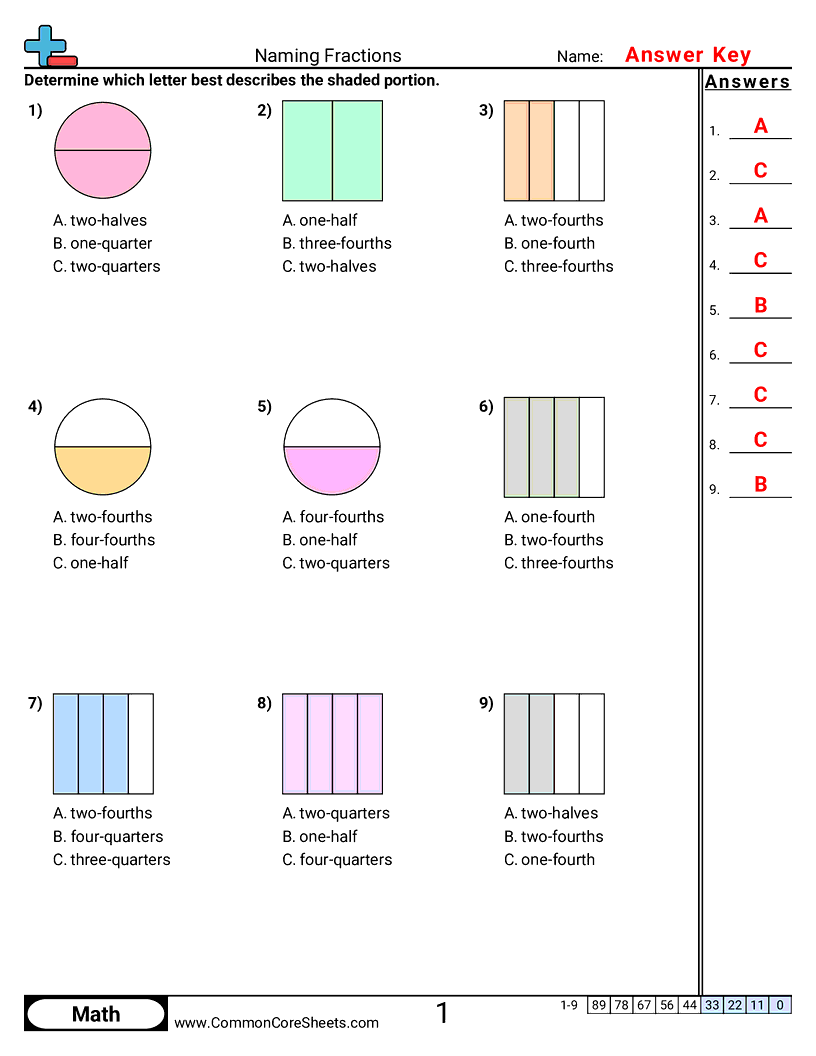
- Match a written fraction name (like “three fourths”) to the correct fraction.
- Use the denominator to tell how many equal parts the whole is split into.
- Use the numerator to tell how many parts are being counted.
2g3
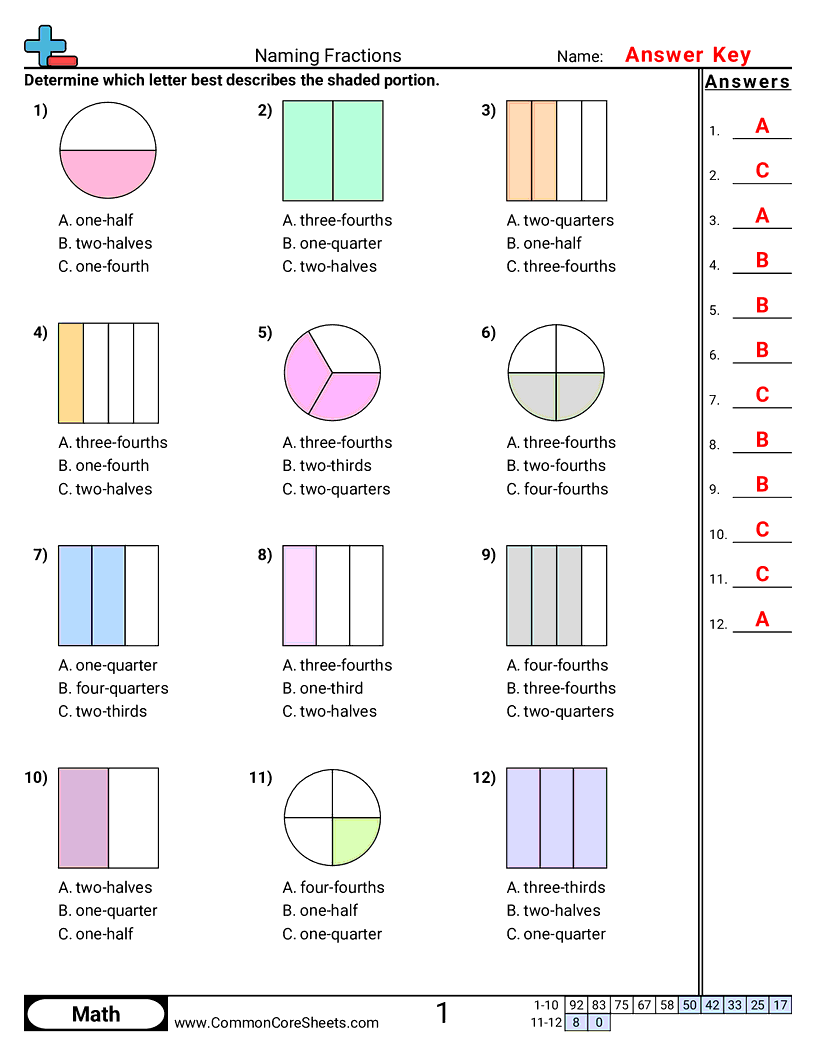
- Read a fraction and say its name using the right word for the denominator (like halves, thirds, or fourths).
- Match a written fraction name to the correct fraction.
- Use the denominator to tell how many equal parts the whole is split into.
- Use the numerator to tell how many parts are being counted.
3nf1
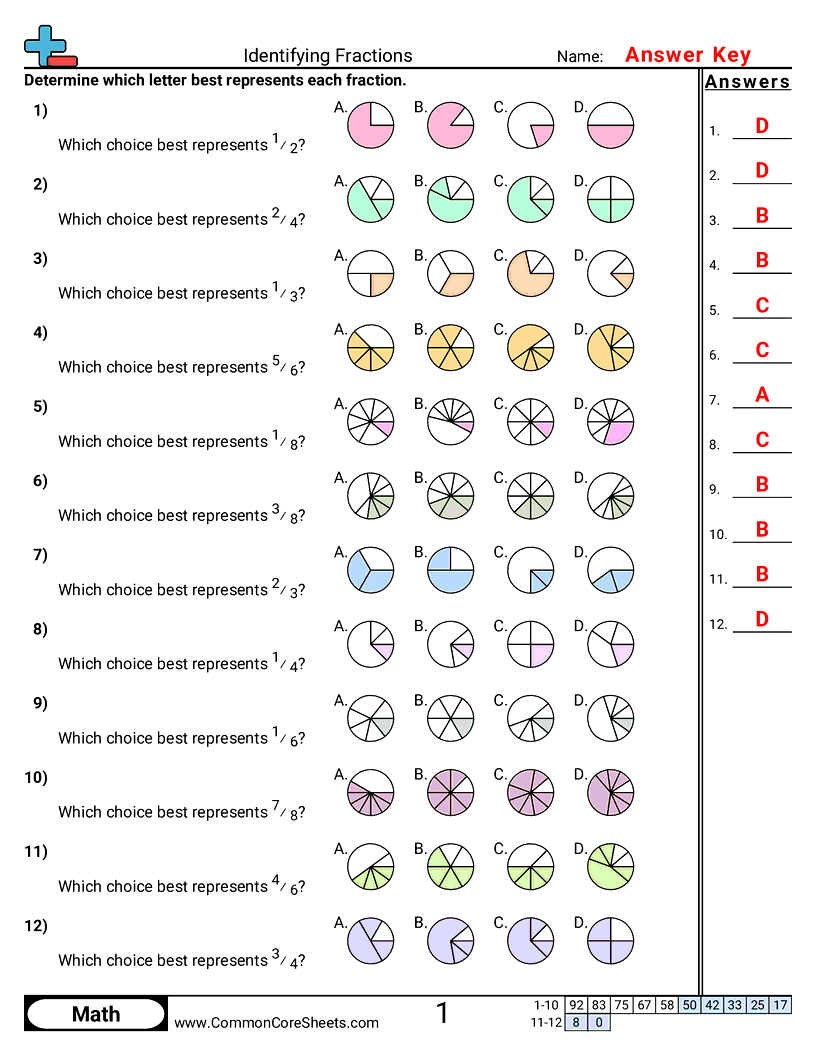
- Match a written fraction to a picture that shows the same amount shaded.
- Tell how many equal parts the whole is split into and how many parts are shaded.
- Notice when pictures show different-sized parts and choose only models with equal parts.
3g2
- Decide whether a shape has been split into equal-size parts.
- Tell the difference between equal partitions and uneven partitions in pictures.
- Connect a partitioned shape to the idea of a fraction as equal parts of one whole.
- Explain why a partition is not correct when the pieces are different sizes.
Multiplying & Dividing Fractions
Link
About these worksheets
Students build fluency with fraction multiplication and division through a wide range of activities. Worksheets cover multiplying fractions by whole numbers and by other fractions, using visual models and number lines, estimating fraction products, cross-cancelling, dividing unit fractions, interpreting fractions as division, distributing fractional amounts, and solving word problems. Topics span fourth through sixth grade Common Core standards.
5nf5b
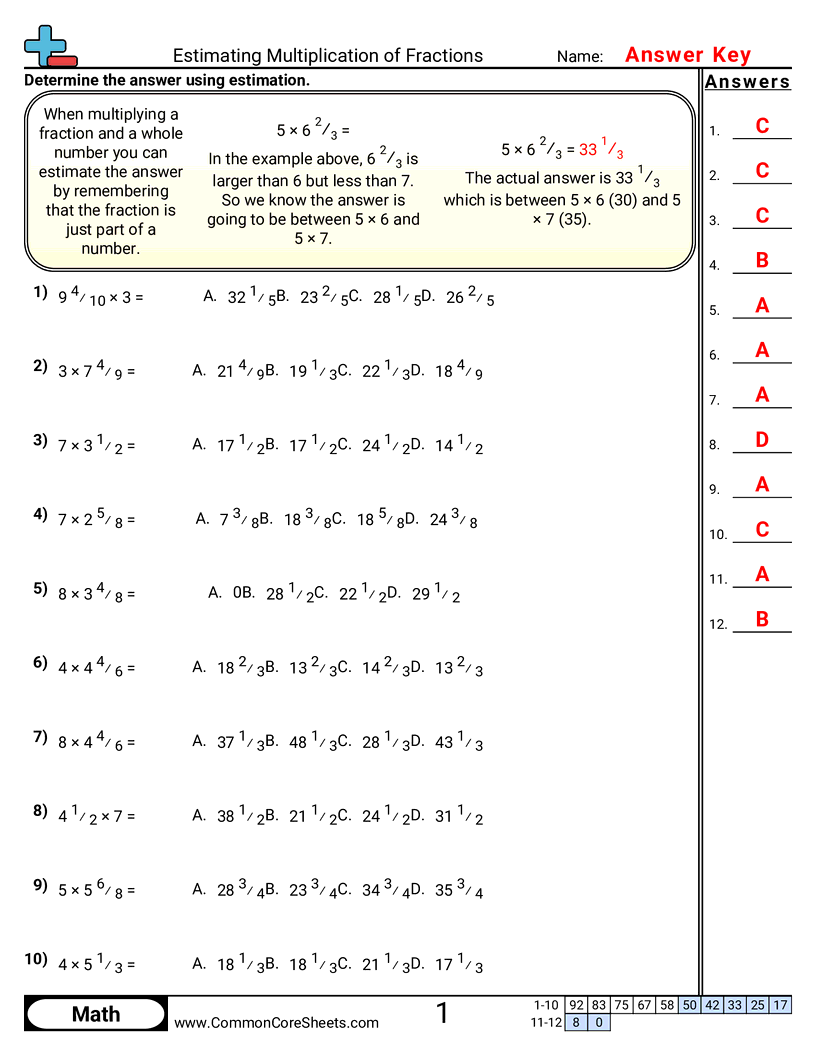
- Estimate the product of two fractions without doing exact multiplication.
- Round fractions to easy benchmark fractions like 0, 1/2, 1, or whole numbers to make mental math quicker.
- Use compatible numbers to get a close estimate for a fraction multiplication problem.
- Decide which estimate makes the most sense by comparing it to the answer choices.
About these worksheets
These worksheets develop fraction comparison skills using multiple strategies. Students compare fractions with same numerators or denominators, compare fractions with different denominators using common denominators, determine whether fractions are greater than, less than, or equal to one-half, order sets of fractions, and use visual models for comparison. Resources span third through fourth grade.
3nf3d
- Compare two fractions and decide which one is greater, less, or if they are equal.
- Fill in the missing fraction to make a comparison statement true.
- Use fraction models or number lines to compare fractions by their size.
- Compare fractions with different denominators by thinking about equivalent fractions or common denominators.
3nf1
- Match a shaded picture or model to the fraction it shows.
- Count equal parts to figure out the denominator and count shaded parts to figure out the numerator.
- Recognize the same fraction shown with different shapes or layouts (like bars, circles, or grids).
3nf3d
- Decide which of two fractions is greater, less, or if they are equal.
- Use fraction pictures or models to compare the size of two fractions.
- Identify the numeric value of a visual fraction model.
- Count equal parts to figure out the denominator and count shaded parts to figure out the numerator.
Equivalent Fractions
Link
About these worksheets
Students learn to create, identify, and work with equivalent fractions. Activities include using visual models and number lines to find equivalent fractions, reducing fractions to simplest form, finding missing numerators or denominators, recognizing equivalent fraction patterns, writing whole numbers as fractions, and simplifying mixed numbers with improper fraction parts. Aligned with third through fourth grade standards.
3nf3c
- Recognize that any whole number can be written as a fraction with a denominator of 1.
- Write whole numbers in fraction form (like 5 as 5/1).
Comparing Fractions, Decimals & Percents
Link
About these worksheets
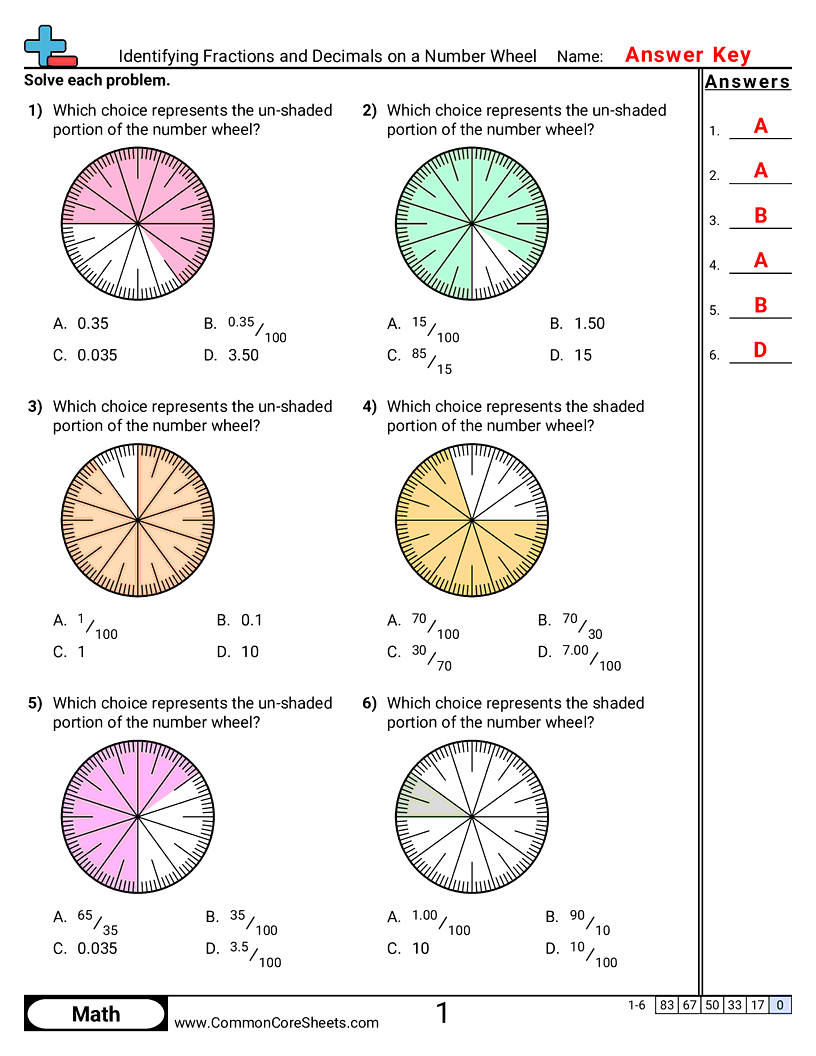
Students develop fluency in comparing and converting between fractions, decimals, and percents. Worksheets include numeric fraction comparison, finding equivalent values across all three forms, using visual models and number lines, and working with number wheels. These resources help students see fractions, decimals, and percents as different representations of the same quantity. Aligned with fourth grade and above.
- Read a shaded section on a number wheel and name it as a fraction of the whole.
- Read a shaded section on a number wheel and name it as a decimal value.