Division Worksheets
Free division worksheets with answer key. No login or account needed. From the basics of visual problems to more complex long division problems to word division problems, we've got you covered. A grading column and quick grade scale maker grading a breeze and a modified pages help with lower level learners or when just introducing a topic. Great for teachers or for homeschool.
×
Preparing For Division
Link
About these worksheets
These worksheets prepare students for division by building the prerequisite skills they need. Activities include relating division to multiplication, completing multiplication and division charts, using number lines to model division, understanding how many times one number goes into another, checking division answers with multiplication, interpreting remainders in word problems, and modeling division as repeated subtraction. Spanning third through fourth grade standards.
3oa6
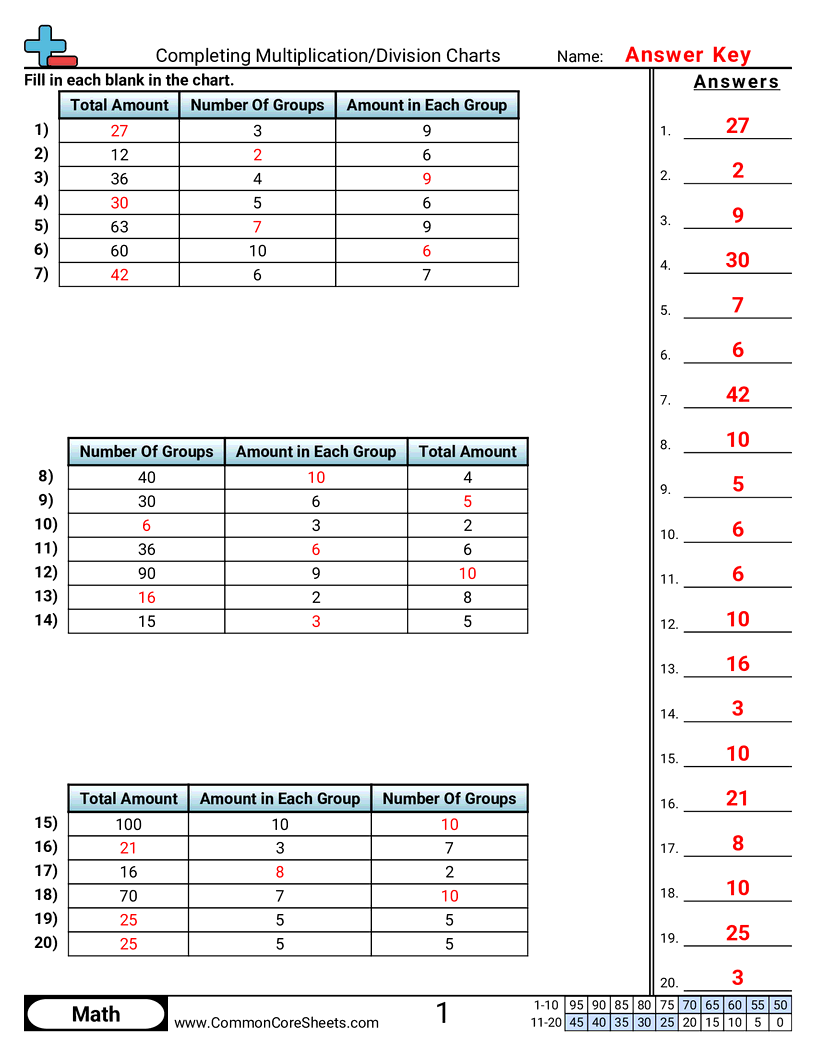
Use multiplication facts to solve division problems. Explain how division and multiplication are connected as opposite operations. Find the missing number in a related multiplication or division fact. Use a multiplication fact to check whether a division answer makes sense.
3oa6
Use multiplication facts to figure out related division facts. Find missing numbers in multiplication and division equations. Build speed and accuracy with basic multiplication and division facts.
3oa1
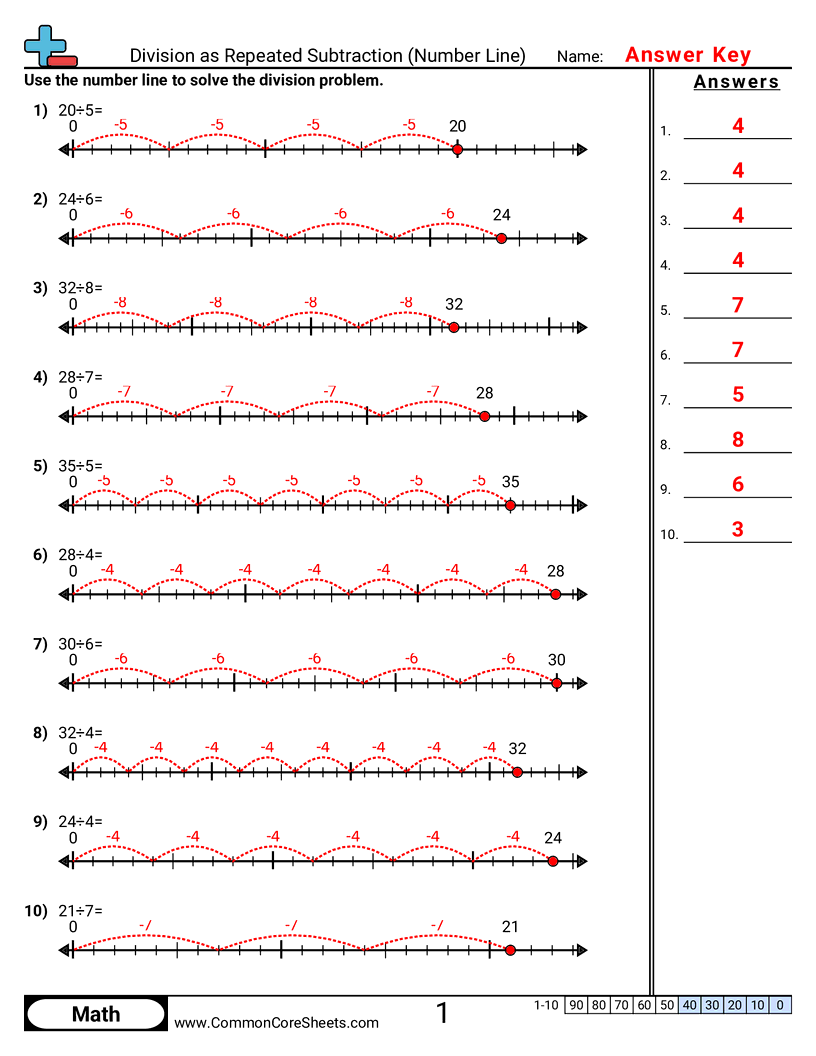
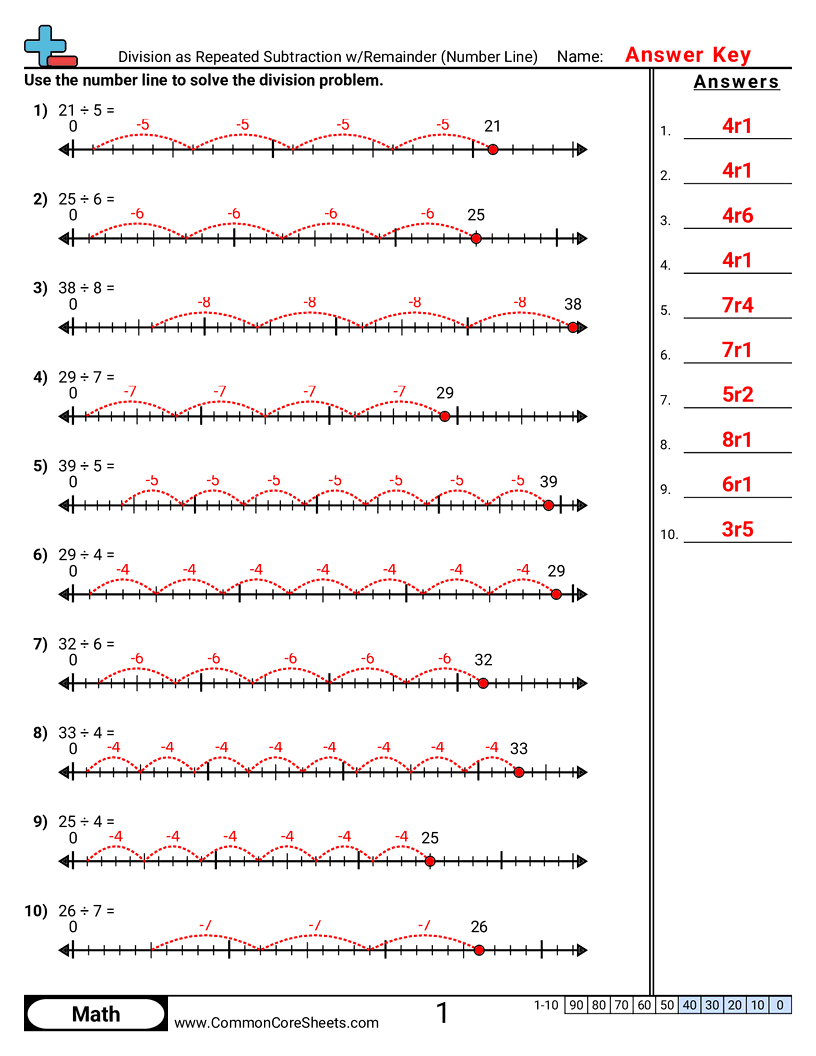
Use a number line to solve division problems by making equal jumps. Count how many jumps it takes to reach the total to find the quotient. Understand division as repeated subtraction on a number line.
4nbt6
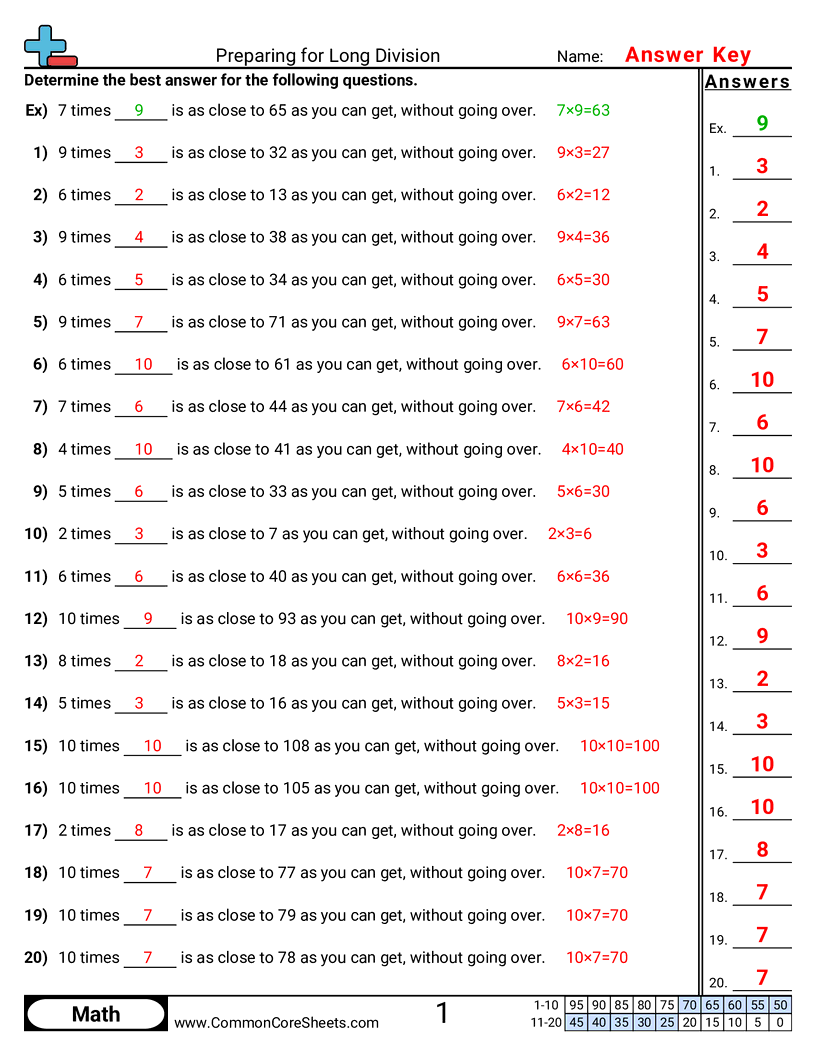
Practice figuring out how many times one number goes into another number. Use multiplication facts to find division answers faster.
4nbt6
Use multiplication to check whether a division answer makes sense. Check division problems that have remainders by multiplying and adding the remainder. Spot when a quotient or remainder is incorrect by comparing it to the original dividend.
4oa3
Read a division word problem and decide what the quotient is telling you in the story. Figure out what to do with a remainder (share it, ignore it, or round up) so the answer makes sense.
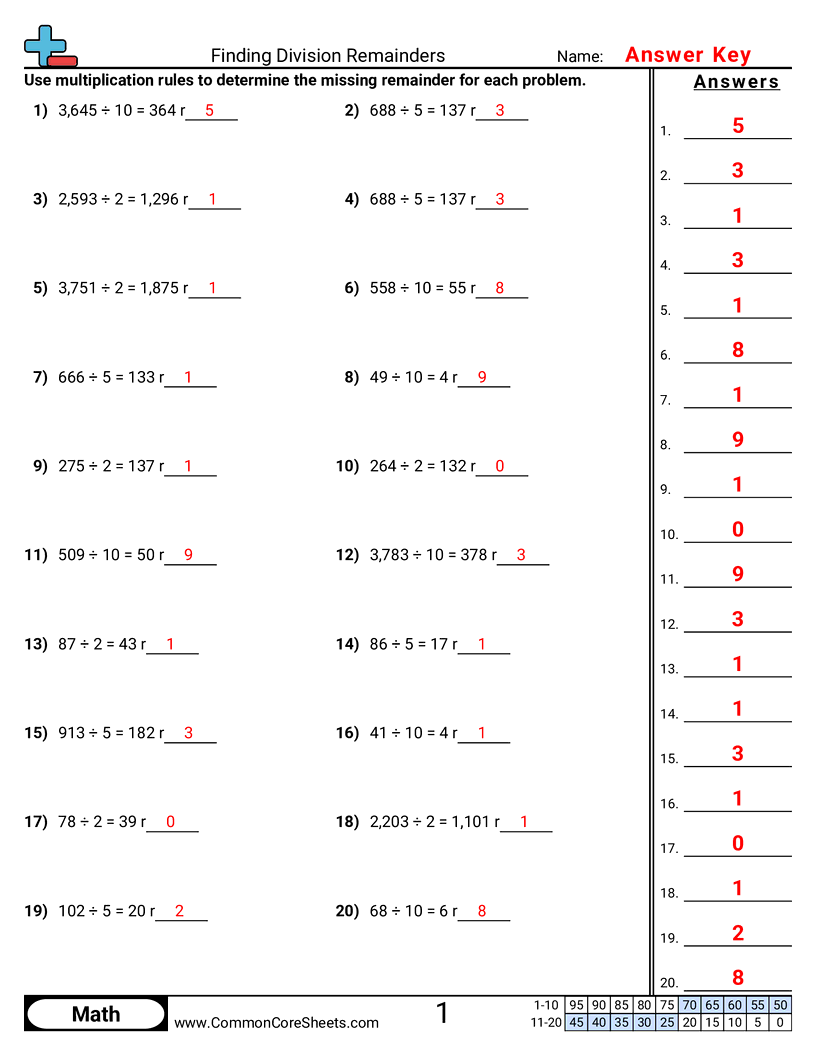
Practice dividing by 2, 5, and 10 and naming the remainder. Learn to tell when a number divides evenly and when there will be leftovers.
Use a number line to solve division by making equal jumps backward. Understand division as repeated subtraction until you reach zero. Count how many equal jumps it takes to find the quotient.
Use a number line to solve division by making equal jumps backward over and over. Count the jumps to find the quotient in a division problem. Figure out the remainder by seeing how many are left when you can’t make another full jump. Write the answer as a quotient with a remainder (for example, 17 ÷ 5 = 3 R2).
About these worksheets
Visual division worksheets use pictures and grouping models to help students understand the concept of division. Students identify how many equal groups can be made from a set of objects and determine any leftover amounts. These hands-on activities make division concrete before students move to traditional algorithms.
3oa2
Use pictures or objects to figure out how many equal groups can be made. Write a division equation to match a grouping picture or model. Find the quotient when items are shared equally with no leftovers. Check that the groups are equal and that every item is used.
4nbt6
Divide items into equal groups and tell how many groups you can make. Figure out how many items are left over when they don’t split evenly. Write the answer as a quotient with a remainder.
Traditional Division
Link
About these worksheets
These worksheets cover traditional long division methods across multiple skill levels. Students practice dividing within 100, dividing three- and four-digit numbers by one- and two-digit divisors, handling zeros in the quotient, using partial quotients, dividing with helper grids, and dividing multiples of ten. Both standard and international division formats are included, spanning third through sixth grade.
3oa7
Practice basic division facts from 1 to 10. Figure out how many equal groups you can make from a number. Use division to find how many are in each group when you share evenly. Get faster and more accurate at mental division.
4nbt6
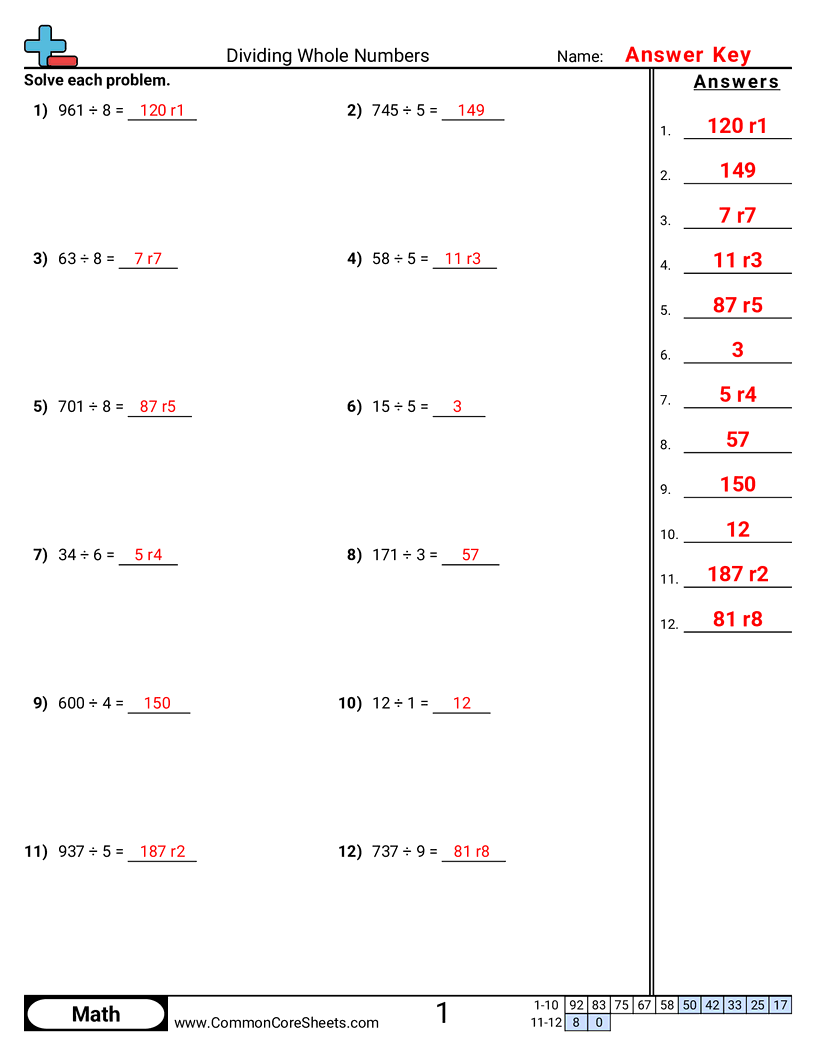
Solve division problems with whole numbers to find the quotient. Use multiplication facts to help divide more quickly and accurately. Work out what to do when the division does not come out evenly (remainders).
4nbt6
Divide a three-digit number by a one-digit number to find the quotient. Work out what to do when the division doesn’t come out evenly and there is a remainder. Use long division steps to keep track of dividing hundreds, tens, and ones in order. Write division answers correctly using a quotient and a remainder.
4nbt6
Divide a 3-digit number by a 1-digit number to find the quotient and remainder. Use partial quotients (chunking) by subtracting groups of the divisor until the dividend is used up. Add the partial quotients to get the final quotient and keep track of what is left over.
4nbt6
Practice long division with three-digit numbers divided by a single-digit number Work through each step of long division: divide, multiply, subtract, bring down Find the remainder when a number doesn't divide evenly Handle zeros in the quotient when a digit is too small to divide
4nbt6
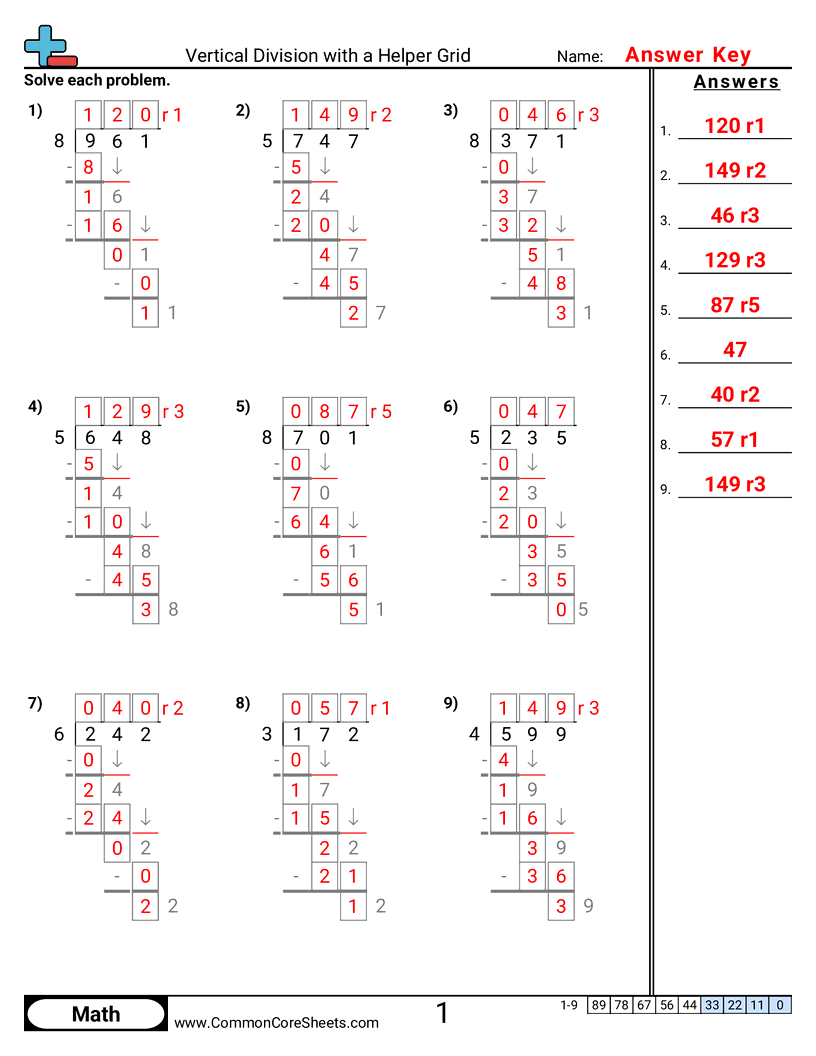
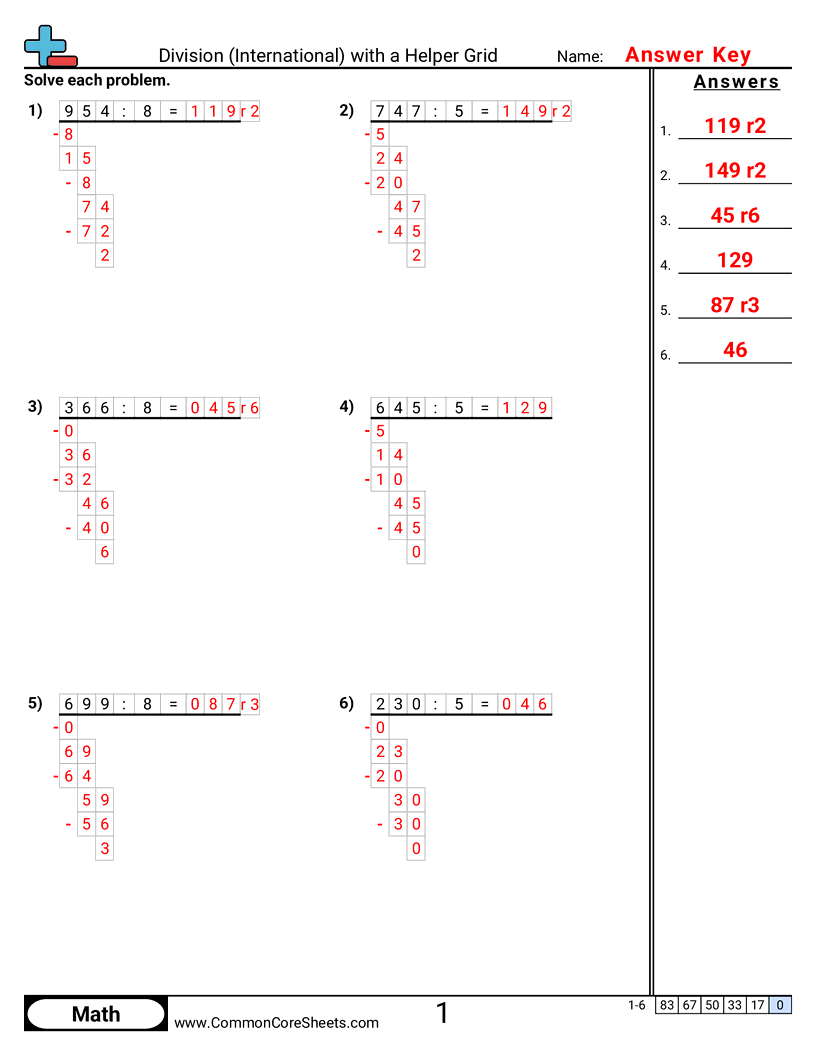
Practice dividing multi-digit numbers using the long division steps in order. Use a helper grid to keep the divisor, dividend, quotient, and subtraction work lined up correctly. Find the correct quotient digits by working place value from left to right. Subtract and bring down digits to continue dividing until the problem is finished. Recognize when there is a remainder and write it correctly.
5nbt6
Practice dividing a 4-digit number by a 2-digit number using long division. Learn to keep the digits lined up correctly as you bring down the next digit in the division steps. Work with quotients that have a remainder and write the remainder correctly. Use multiplication and subtraction within the long-division steps to find each part of the quotient.
5nbt2
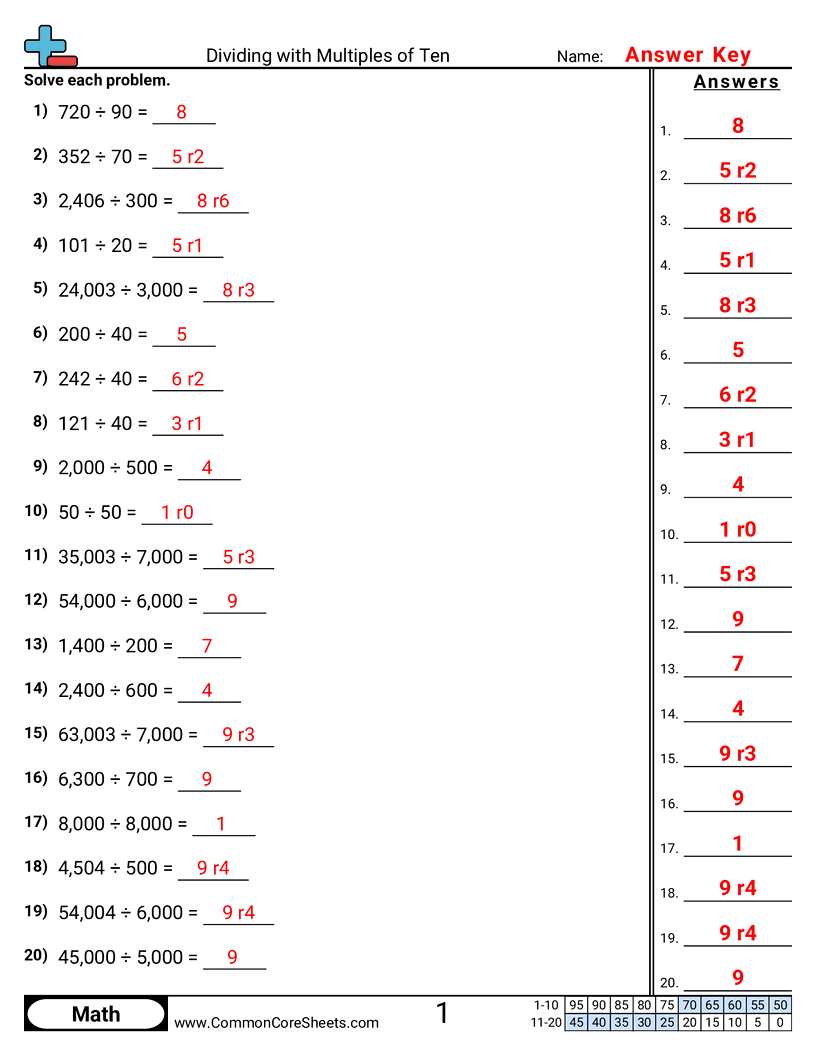
Divide numbers that end in zeros by 10, 100, or 1,000. Use place value to move digits to the right when dividing by powers of ten. Solve division facts with multiples of ten quickly in your head.
5nbt6
Divide a 4-digit number by a 2-digit number using long division. Find the correct quotient digits step by step by subtracting and bringing down. Write and interpret remainders when the division does not come out evenly. Keep numbers lined up correctly in vertical division so each step matches the right place value.
5nbt2
Use place value to make division with tens, hundreds, and thousands quicker. Keep track of zeros correctly when dividing by 10, 100, or 1,000. Solve division facts mentally when the numbers are multiples of ten.
6ns2
Practice dividing whole numbers to find the quotient. Work through division step by step to keep track of what to subtract and bring down next. Handle division problems that leave a remainder. Write division neatly so the digits stay lined up in the right place.
Practice dividing multi-digit numbers using the long division steps. Use a helper grid to keep place values lined up while you divide. Find the quotient and any remainder in a division problem. Bring down digits and continue dividing until the problem is finished.
Practice dividing multi-digit numbers using the long division steps. Use the helper grid to keep each step lined up in the right place value. Find quotients and remainders when the division does not come out evenly. Write the final answer correctly, including any remainder.
About these worksheets
Division word problems help students apply division skills to real-world situations. Worksheets progress from one-digit quotient problems using basic facts to three-digit dividends with one- and two-digit divisors, including problems with and without remainders. Students practice interpreting what remainders mean in context. Aligned with third through fifth grade standards.
3oa8
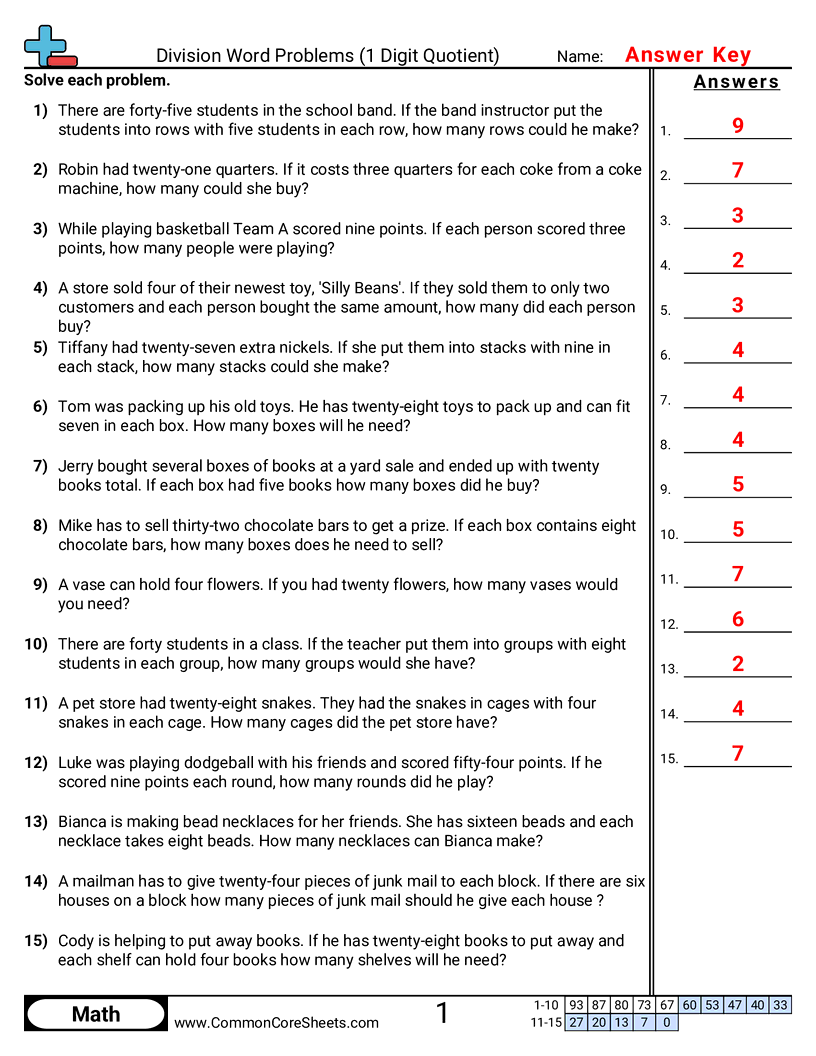
Use multiplication facts (1×1 through 9×9) to figure out division answers quickly. Understand division as making equal groups and finding how many are in each group. Read simple word problems and decide what division fact to use to solve them.
3oa8
Divide a number into equal groups when the answer is a single-digit number. Figure out how many are in each group and how many are left over (the remainder). Use basic multiplication facts (1×1 to 9×9) to help solve division problems. Solve simple division word problems that involve sharing with leftovers.
4nbt6
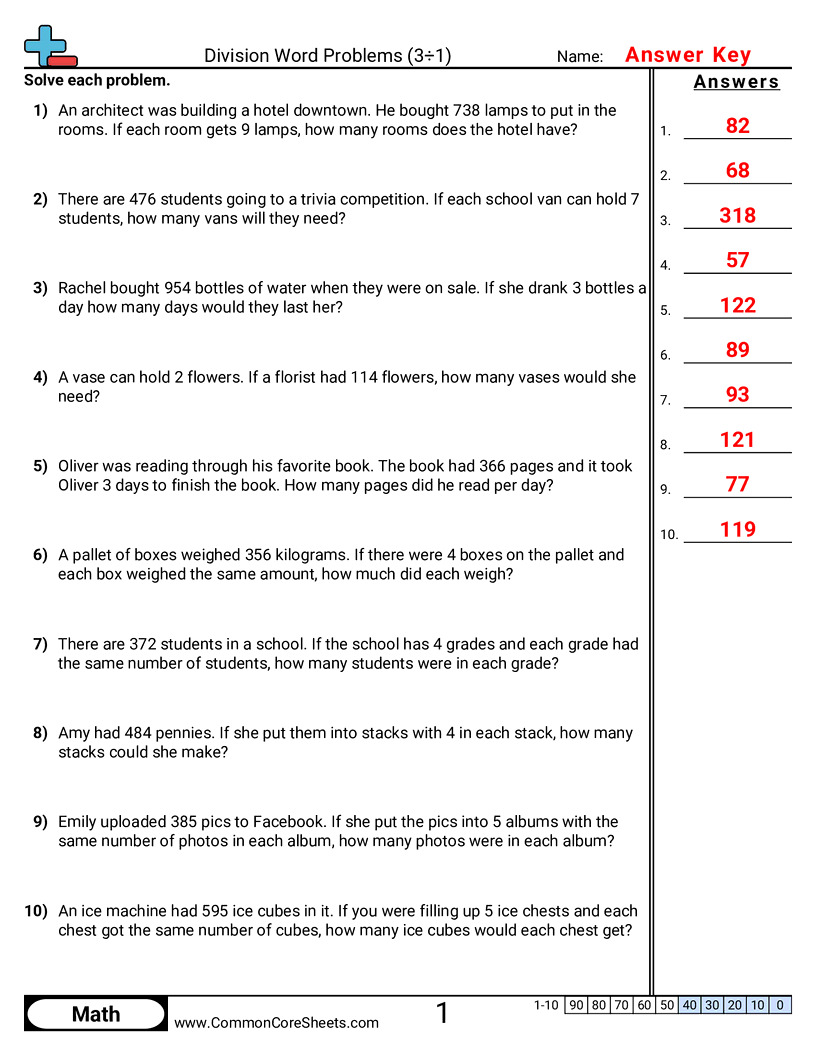
Practice dividing three-digit numbers by one-digit numbers to solve real-world word problems Read a story problem and figure out that division is the right operation to use Find how many equal groups can be made or how many are in each group
4nbt6
Practice dividing three-digit numbers by one-digit numbers in word problems that have remainders Figure out what the remainder means in the story — like how many are left over, or how many more are needed Decide whether the answer should use the quotient, the remainder, or round up based on what the question asks
5nbt6
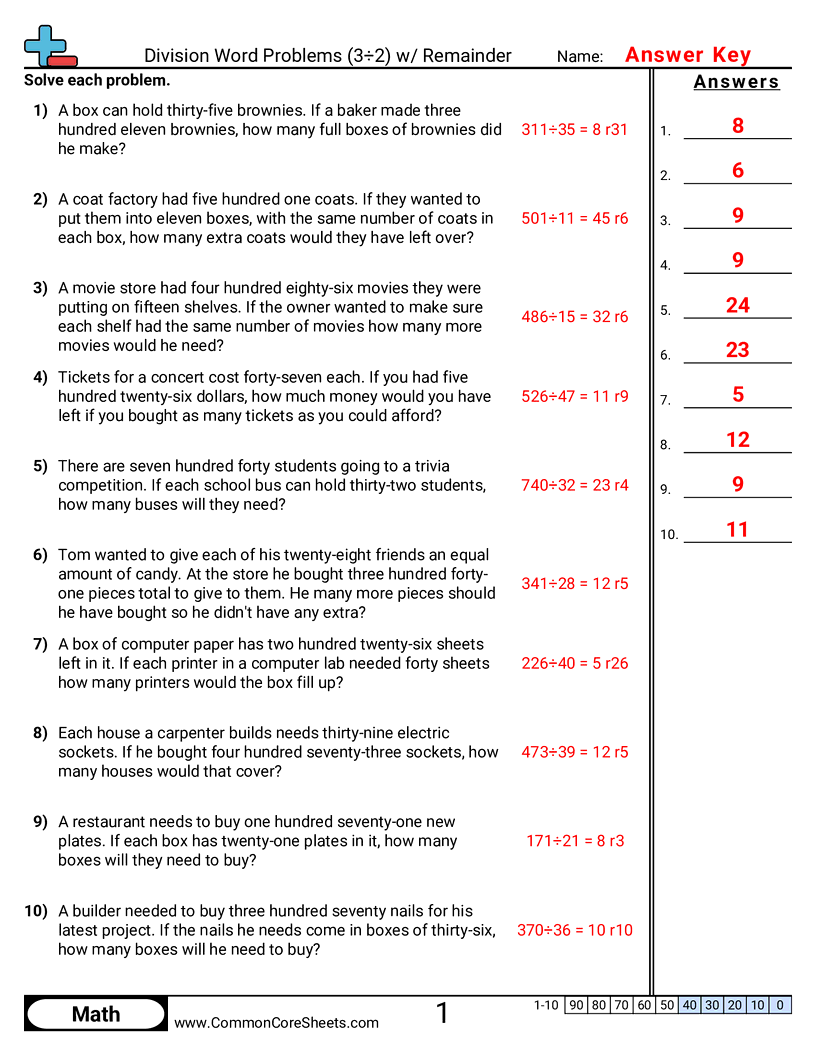
Practice dividing three-digit numbers by two-digit numbers in word problems that have remainders Figure out what the remainder means in the story — like how many are left over, how many more are needed, or how much money remains Decide whether the answer should use the quotient, the remainder, or round up based on what the question asks
Division - Estimating
Link
About these worksheets
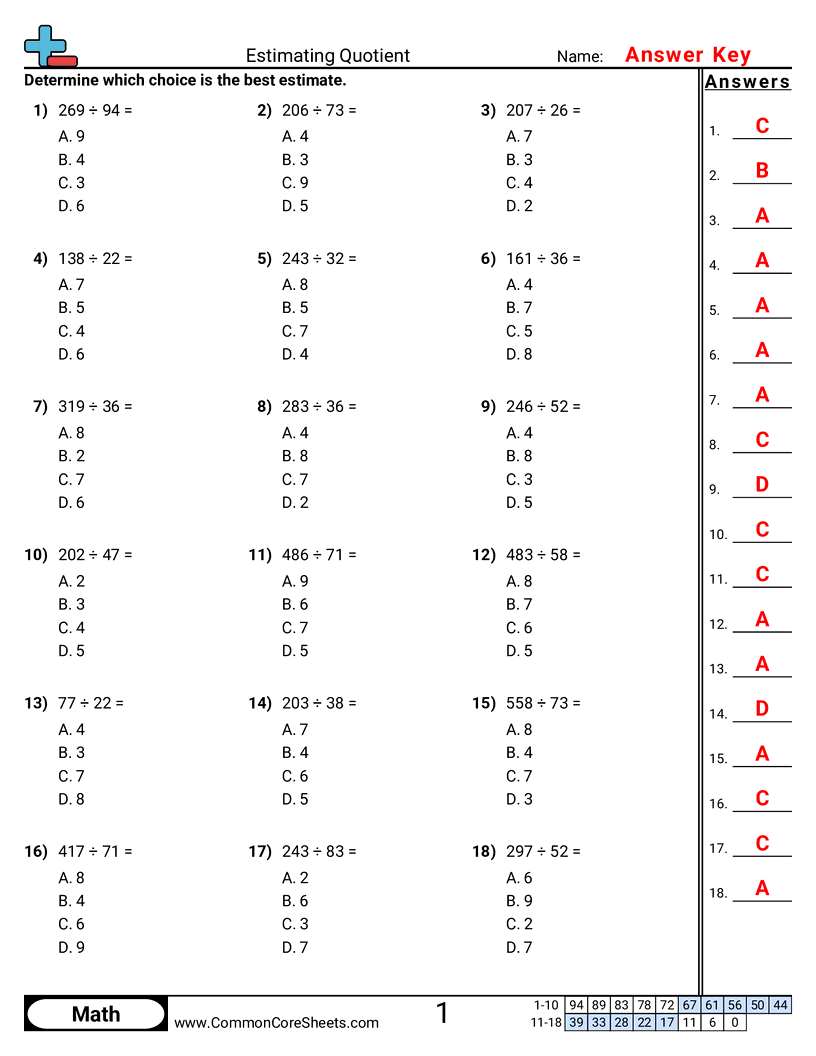
These worksheets develop estimation skills for division. Students practice rounding numbers to find approximate quotients, choosing compatible numbers that divide evenly, and using estimation to check whether exact answers are reasonable. Designed for fourth grade.
4nbt6
Estimate the answer when dividing a 3-digit number by a 2-digit number. Round numbers to make division easier to do in your head. Use compatible (friendly) numbers to find a close quotient. Choose the closest estimate from a set of possible answers.
4nbt6
Estimate the answer to a division word problem by rounding numbers to make them easier to divide. Choose compatible numbers that divide evenly to get a quick, reasonable quotient. Use the estimated quotient to decide about how many groups you can make or how many items go in each group.
About these worksheets
Division drill worksheets build speed and accuracy with basic division facts. Each worksheet contains 100 problems focused on a specific divisor — from 2s through 10s — plus mixed fact sets. These are ideal for timed practice, daily warm-ups, or fact fluency assessments.
Practice dividing numbers by 2 to find half of a group. Get faster and more confident with basic division facts for 2.
Get faster at recalling the division facts for 3 without counting.
Get faster at 4s division facts and quotients.
Get faster and more accurate with 5s division facts from memory.
Get faster and more accurate with the 6s division facts from memory.
Get faster at recalling division facts for 7 without using a calculator.
Get faster at recalling the division facts for 8 without counting.
Get faster and more accurate with 9 division facts from memory.
Practice dividing numbers by 10 quickly and accurately. Learn how dividing by 10 makes the number 10 times smaller.
Practice dividing numbers from 1 to 10 and saying the quotient quickly. Build accuracy with basic division facts so harder division problems feel easier later. Recognize that division is the opposite of multiplication for the same fact family.
Divide numbers by 2 to find half of a number. Use division facts for 2 to answer problems quickly and accurately.
Playwire Advertisement