About these worksheets
These worksheets introduce students to the concept of variables and algebraic thinking. Activities include using substitution to evaluate expressions, writing and graphing inequalities on a number line, identifying numerical coefficients, solving for unknown values using all four operations, and exploring powers, bases, and slope. Aligned with sixth through eighth grade standards, these resources build the foundation for pre-algebra and algebra.
6ee5


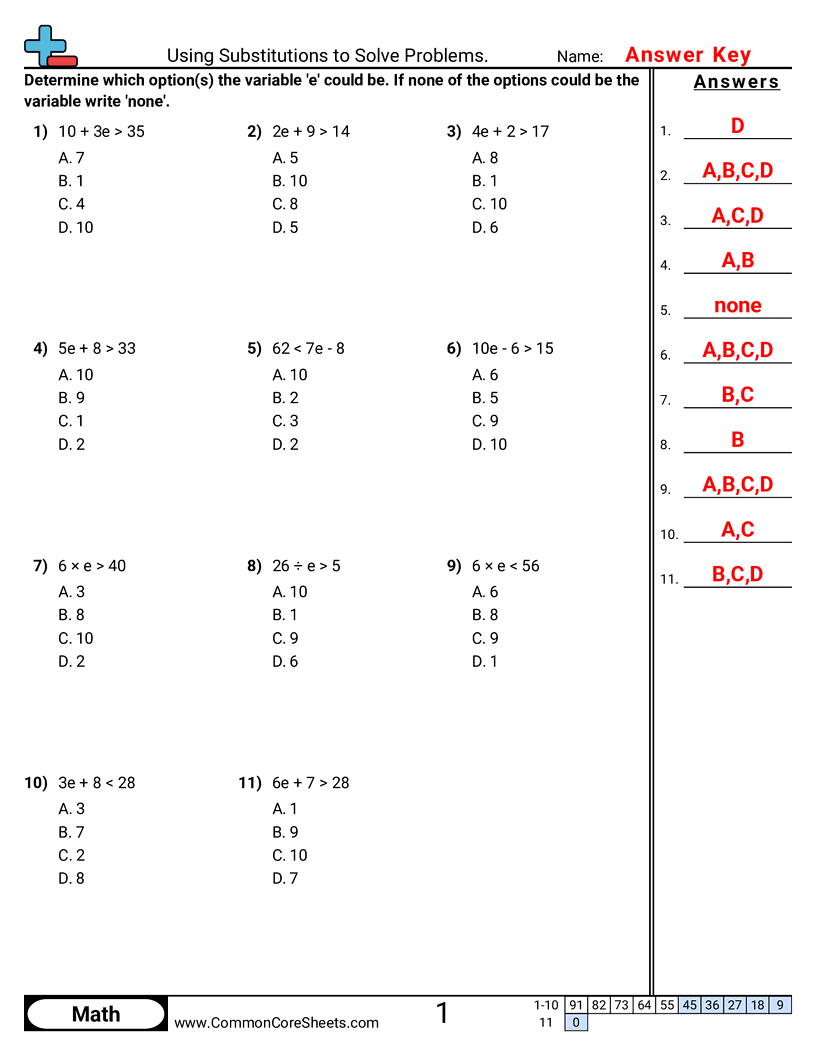
- Replace a variable with a given number and simplify the expression.
- Use substitution to find the value of an unknown in an equation.
- Check whether a number makes an equation true by substituting it in.
6ee8
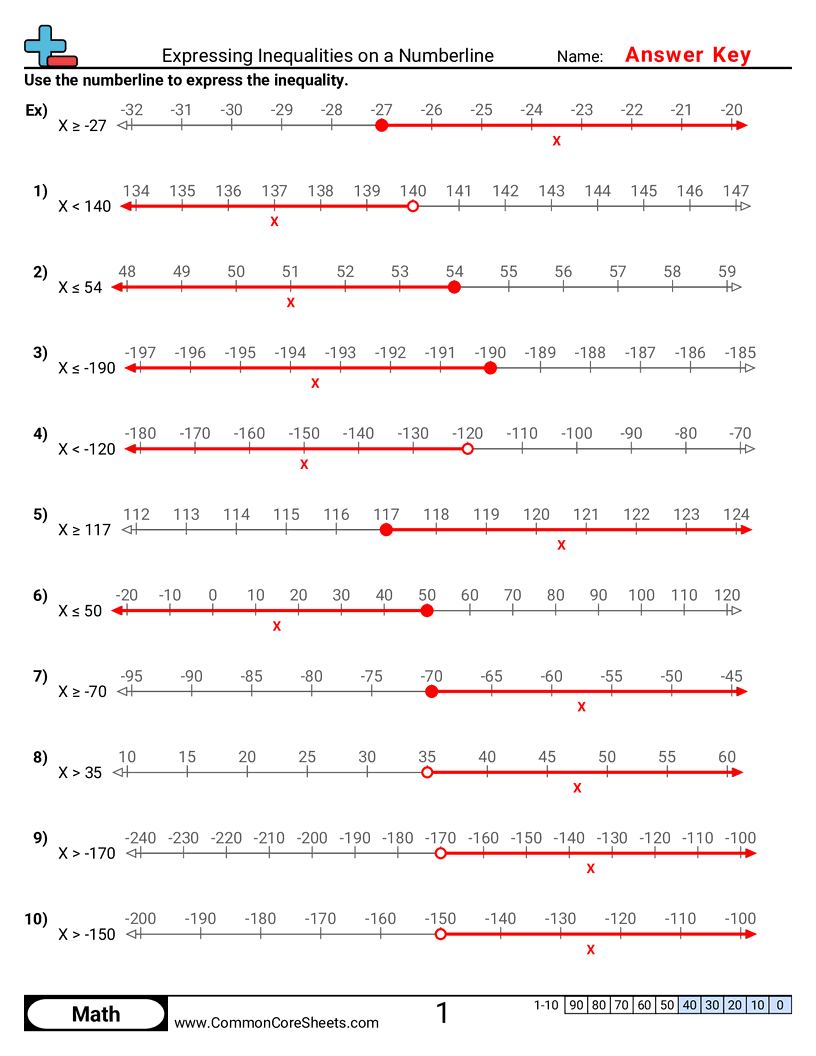
- Read an inequality sign (>, <, ≥, ≤) and say what values it allows.
- Graph an inequality on a number line by choosing an open or closed circle and shading the correct direction.
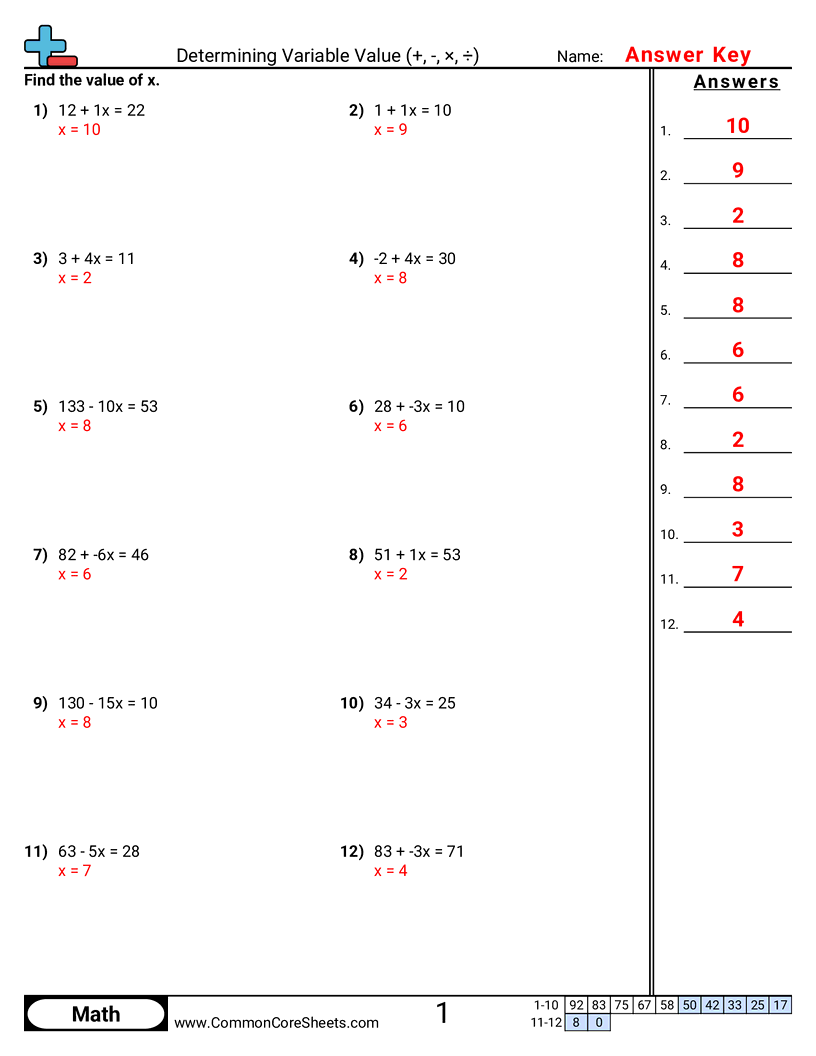
- Solve simple equations to find the missing number or letter.
- Work with equations written in a horizontal format (like x + 7 = 15).
- Check that the value you found makes the equation true when you plug it back in.
6ee3
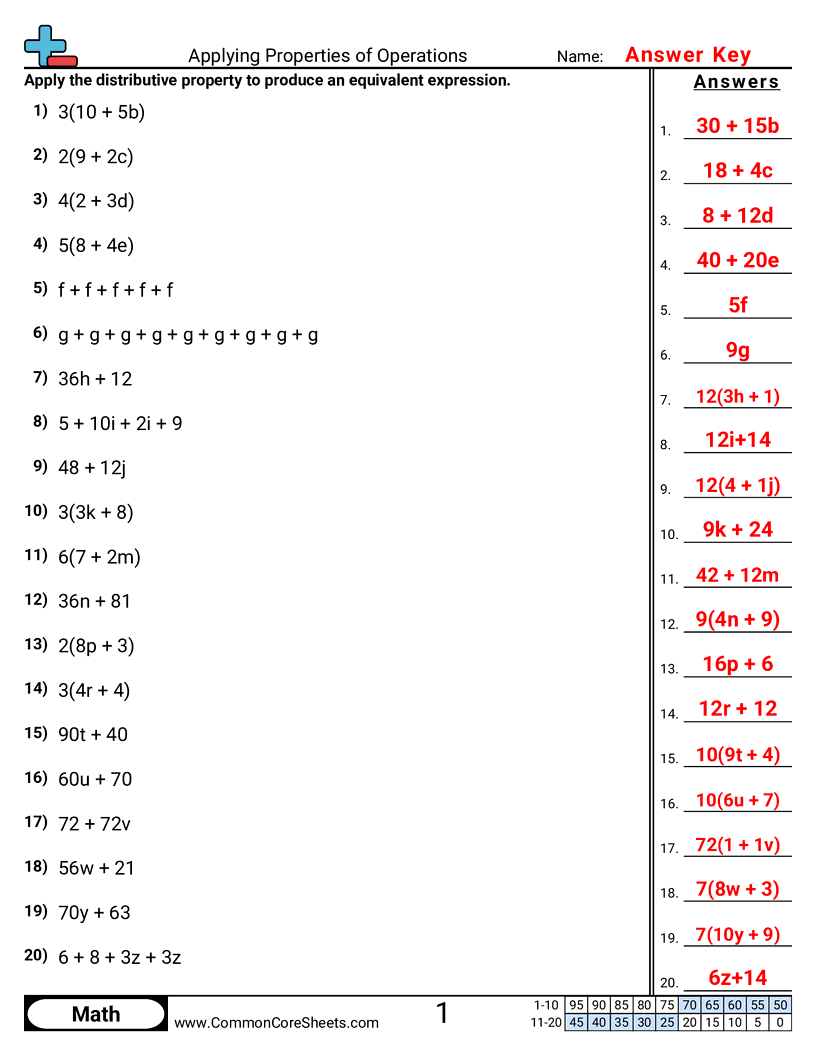
- Rewrite an equation in a different order or grouping without changing its value.
- Use the distributive property to expand or factor expressions to make an equivalent equation.
About these worksheets
Students practice expressing proportional relationships as equations and solving circle equations in standard form. These worksheets develop the ability to identify constants of proportionality, use variables to model real-world relationships, and apply algebraic techniques to geometric formulas. Suitable for seventh and eighth grade math.
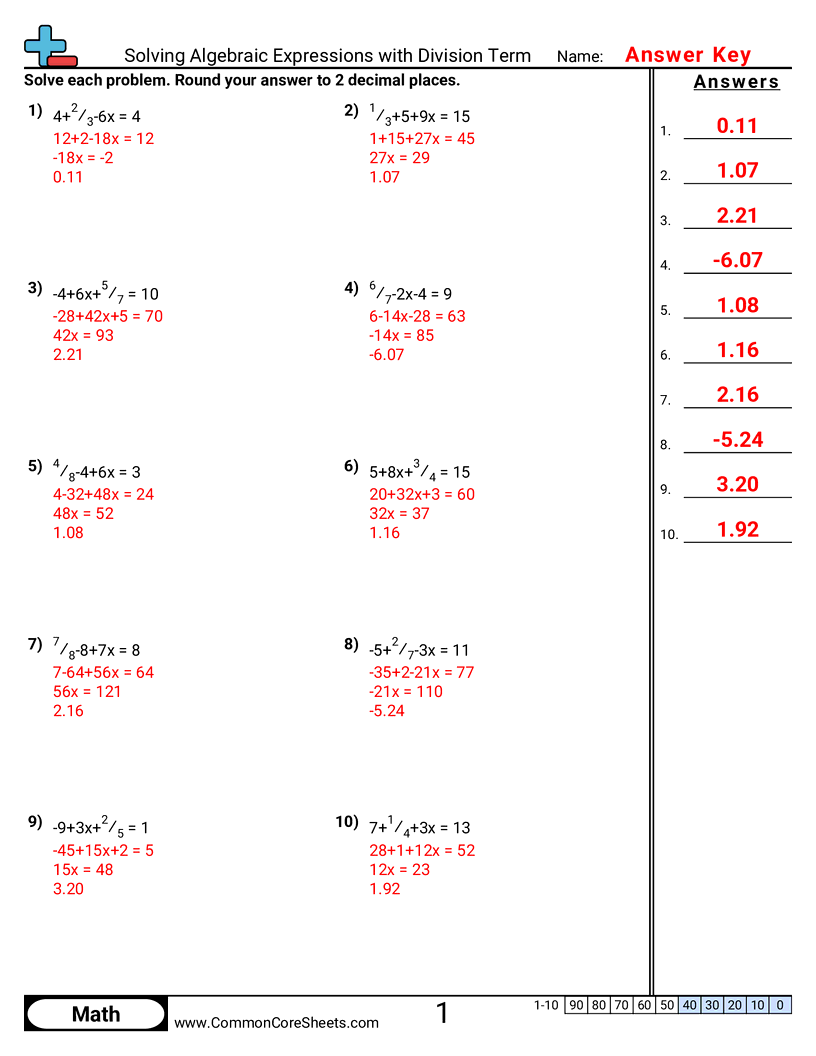
- Solve for a variable when it is being divided by a number.
- Keep equations balanced by using multiplication or division to isolate the variable.
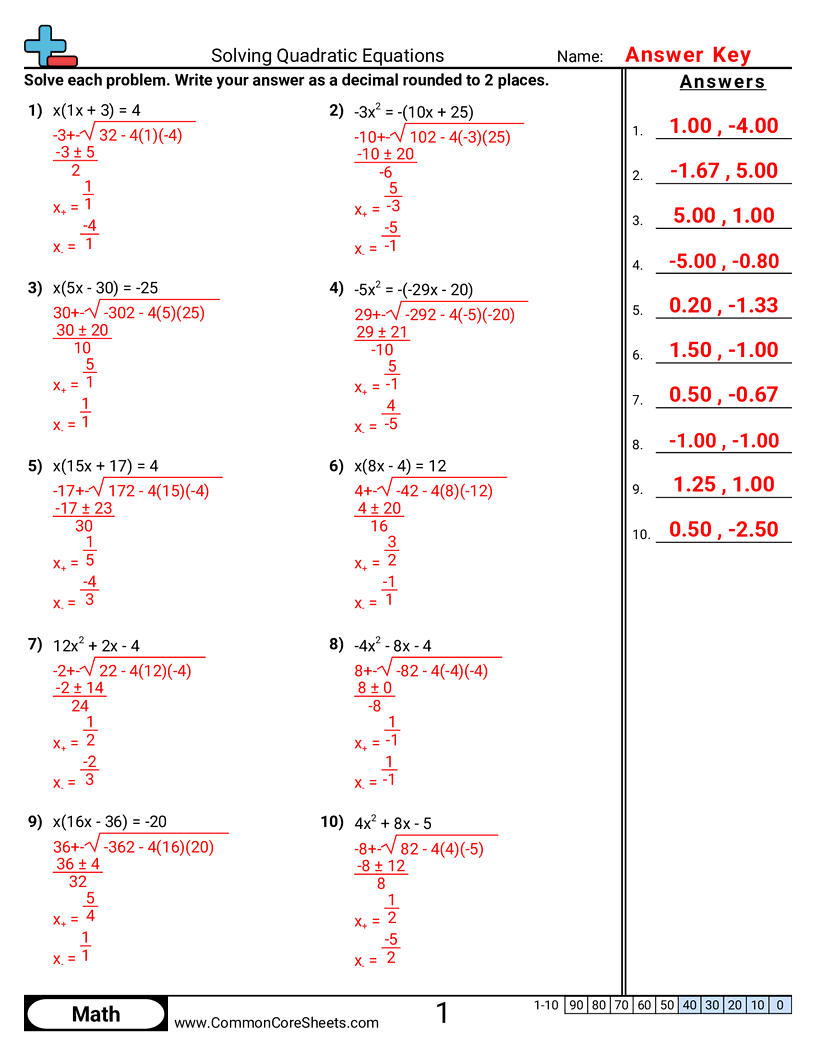
- Solve quadratic equations to find the values that make the equation true.
- Factor a quadratic expression and use the zero product rule to find the roots.
- Use the quadratic formula to solve equations that don’t factor nicely.
About these worksheets
These worksheets cover a wide range of algebraic expression skills, from simplifying and expanding to factoring. Students practice combining like terms, using the distributive property, rewriting expressions as multiples of a sum, solving linear equations with variables on both sides, and expanding polynomials using the box method. Topics also include perfect square trinomials and matching equivalent expressions, making these resources ideal for sixth through eighth grade algebra.
6ns4
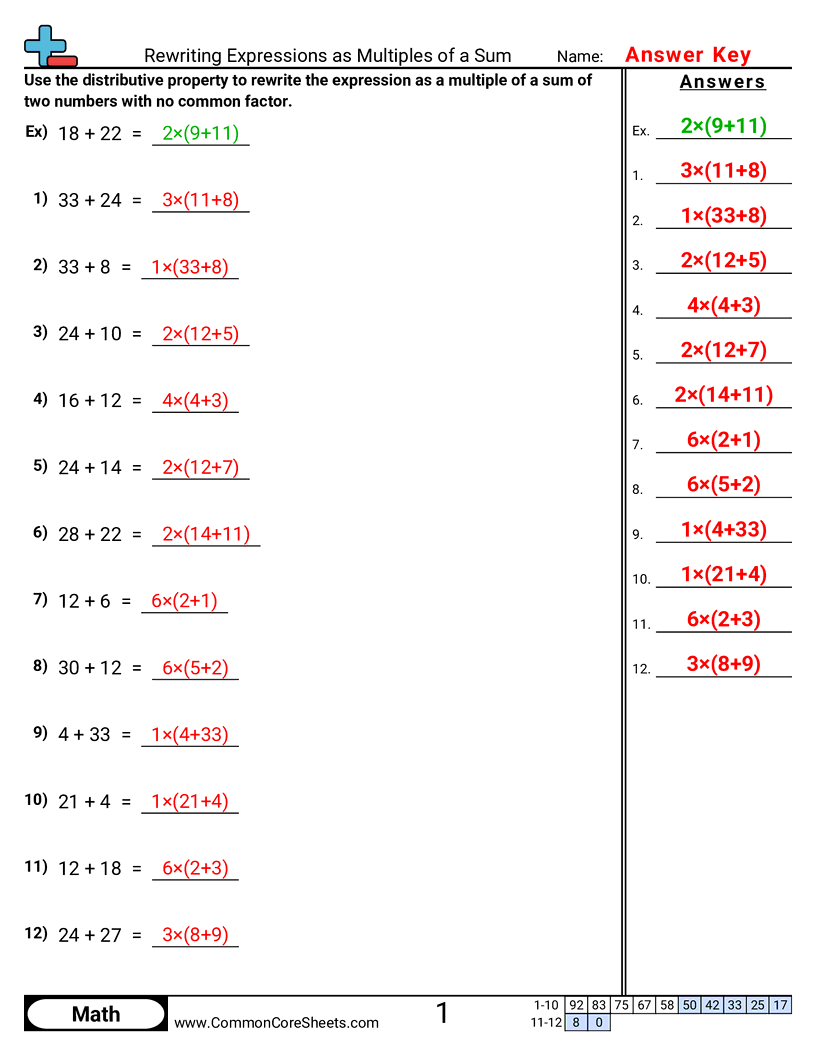
- Rewrite an expression like 3x + 6 as a multiplication problem with parentheses, like 3(x + 2).
- Find the greatest common factor of the terms so you know what number or variable can be factored out.
- Keep expressions equivalent while working with coefficients and variables.
7ee1
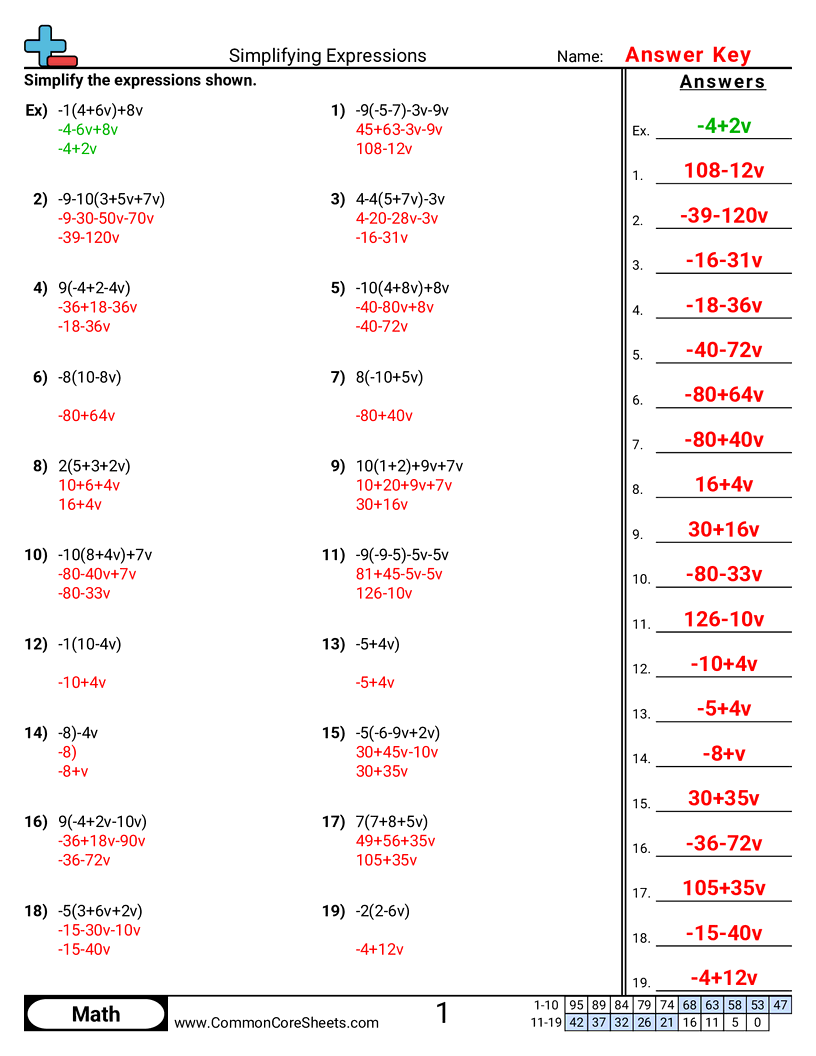
- Practice combining like terms to make an expression simpler.
- Practice using the distributive property to remove parentheses.
- Practice following the order of operations when simplifying expressions with addition and subtraction.
7ee1
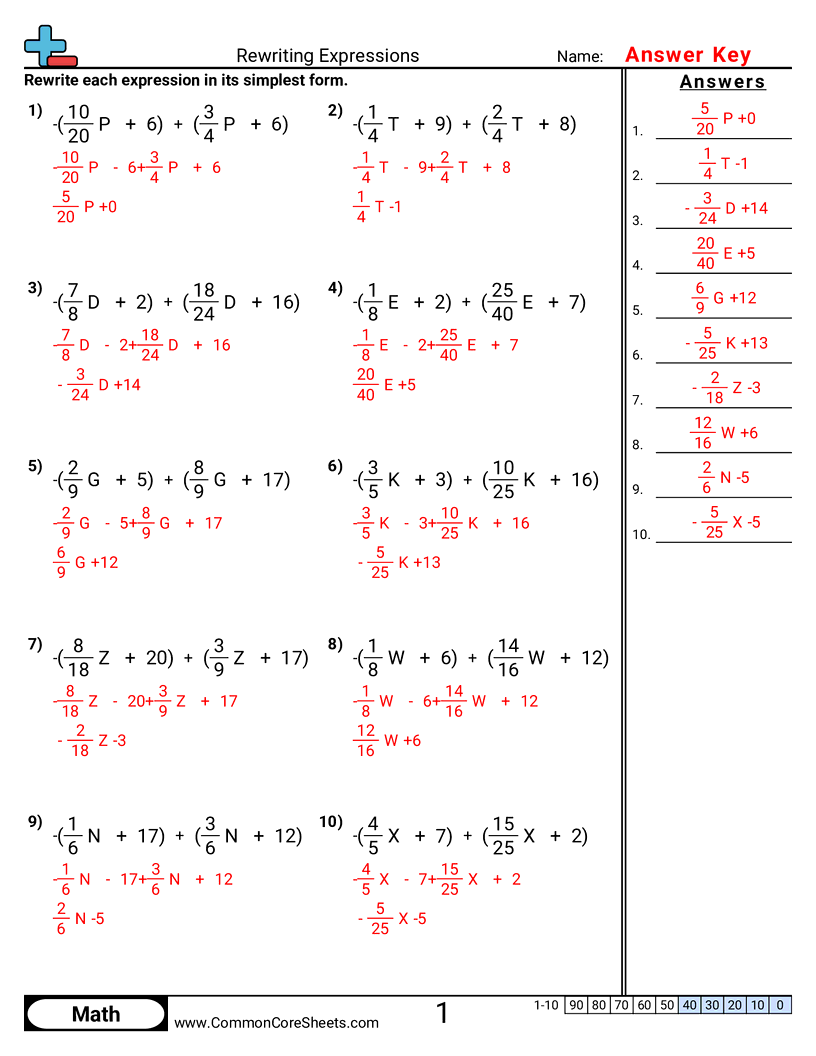
- Rewrite algebra expressions into an equivalent form that’s simpler to read and work with.
- Use the distributive property to expand expressions with parentheses.
- Combine like terms to simplify expressions with variables.
- Rewrite expressions that include fractions by simplifying and combining terms correctly.
7ee1
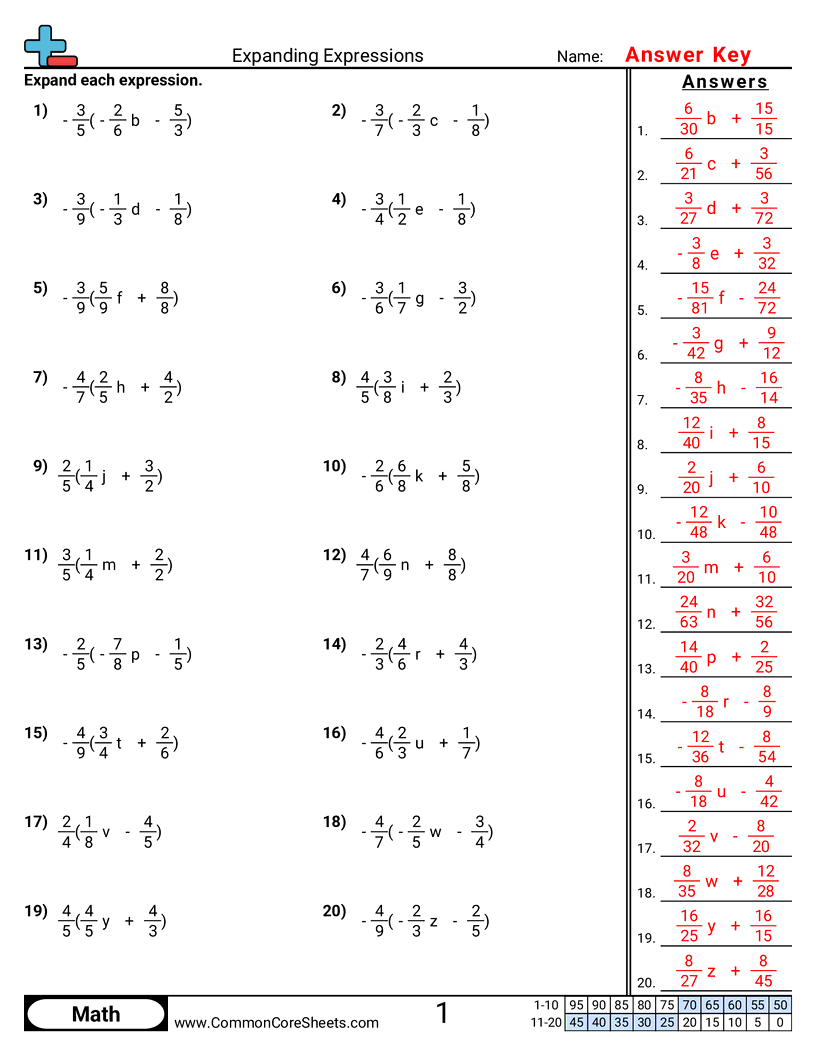
- Practice using the distributive property to remove parentheses in algebra expressions.
- Multiply a number or variable across terms inside parentheses, including with fractions.
- Keep track of positive and negative signs while expanding and simplifying.
7ee1
- Practice pulling out the greatest common factor when the coefficients are fractions.
- Rewrite an expression as a product using the distributive property in reverse.
- Simplify the factored form so the numbers and fractions are in lowest terms.
7ee2
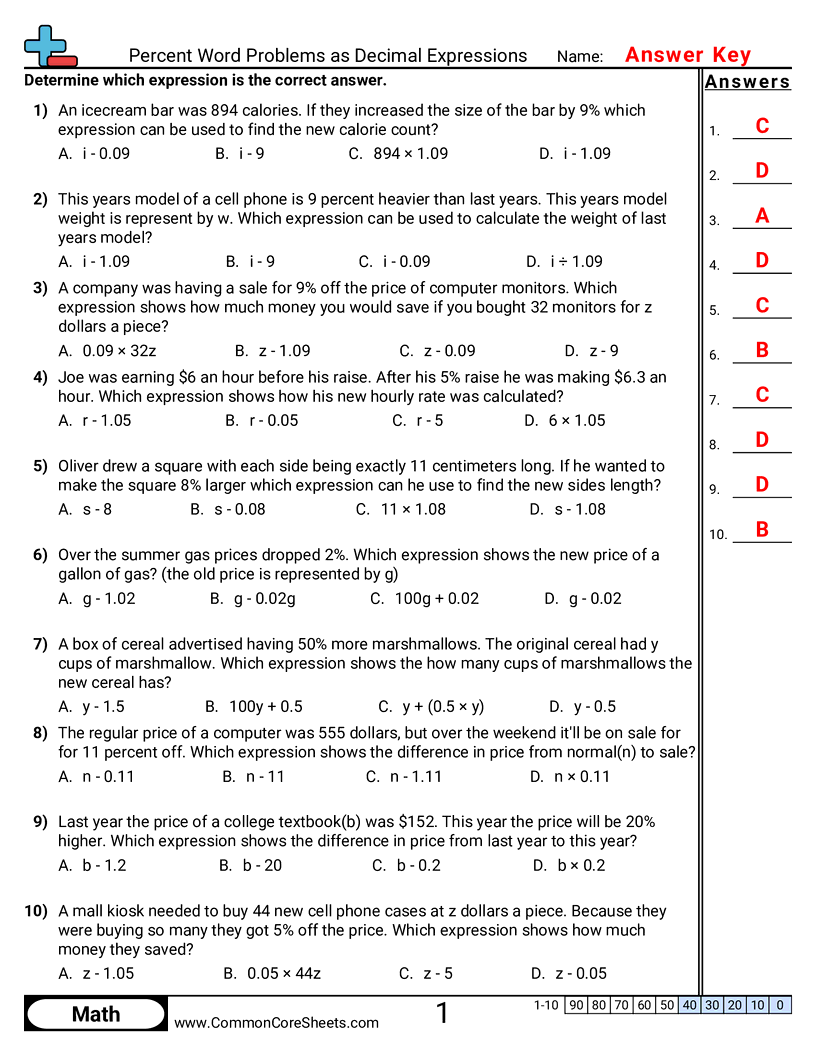
- Turn a percent in a story problem into a decimal you can use in a calculation.
- Match a word problem to the correct decimal expression that represents “percent of” an amount.
- Decide when to multiply by a decimal to find a percent of a number and when to add or subtract to find the new total.
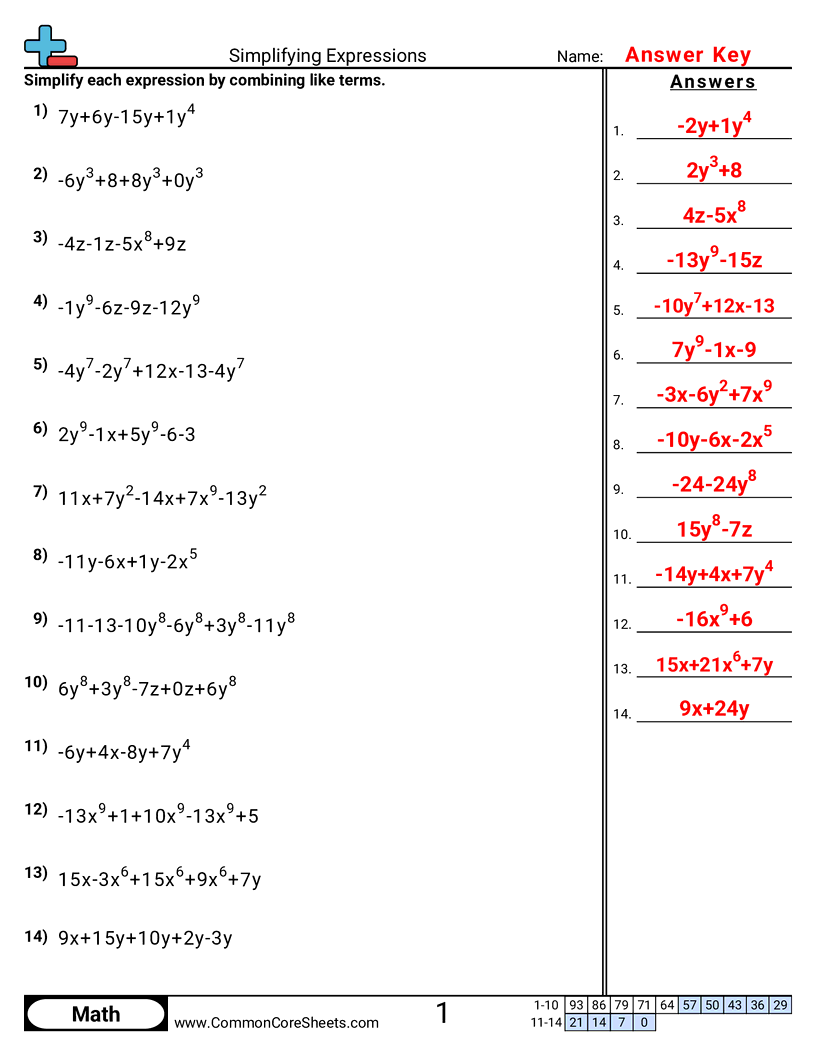
- Combine like terms to make an expression shorter and easier to read.
- Keep track of positive and negative signs while adding and subtracting terms.
- Simplify expressions that include up to three different variables.
6ee4
- Recognize when two algebra expressions have the same value even if they look different.
- Simplify expressions by combining like terms.
- Rewrite expressions by factoring out a common number or variable.
8ee7b
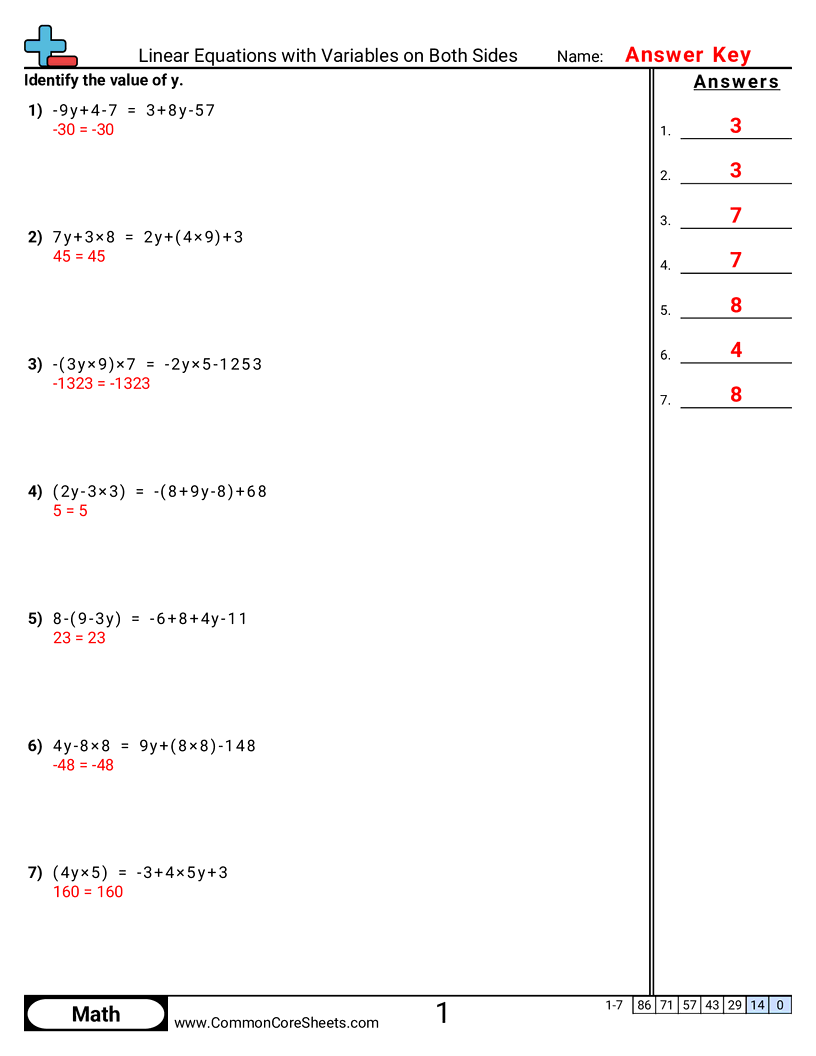
- Solve linear equations where the variable shows up on both sides of the equals sign.
- Combine like terms to simplify each side before solving.
- Use the distributive property to clear parentheses in an equation.
- Move terms across the equals sign using addition, subtraction, and multiplication to isolate the variable.
- Handle equations that need more than one step to get the variable alone.
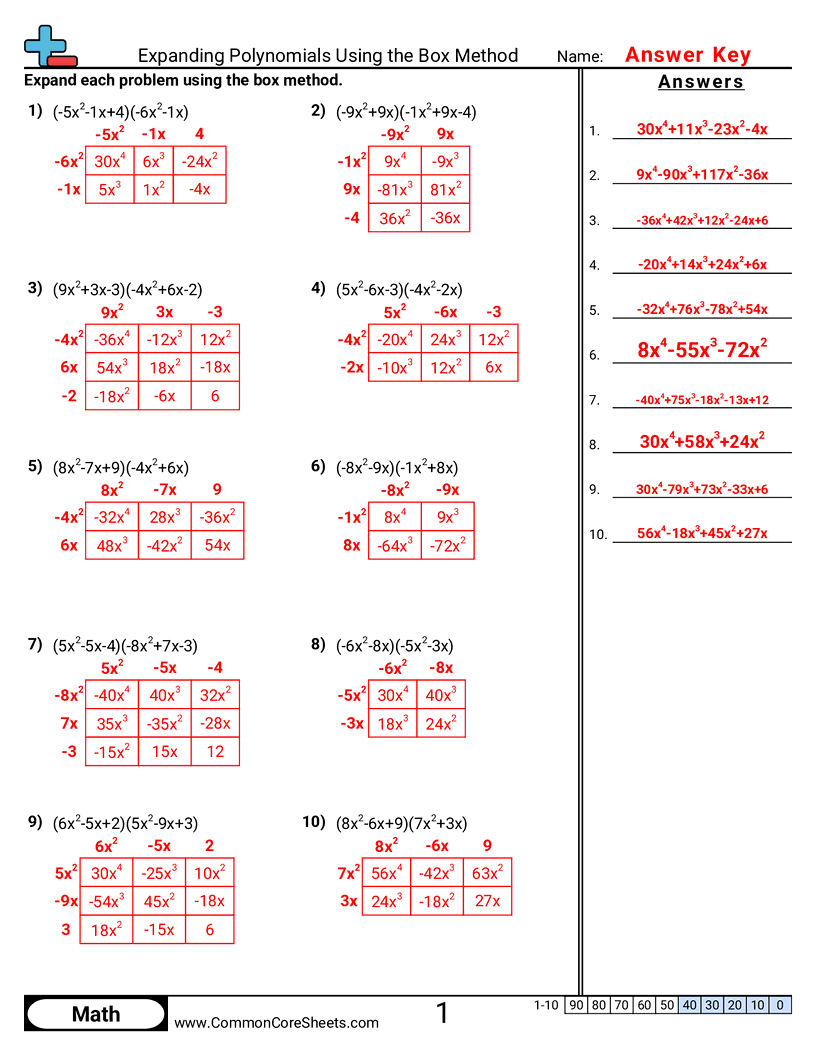
- Multiply two polynomials by breaking them into smaller parts in a box (grid).
- Distribute each term to fill the boxes and keep track of positive and negative signs.
- Combine like terms to write the expanded polynomial in simplest form.
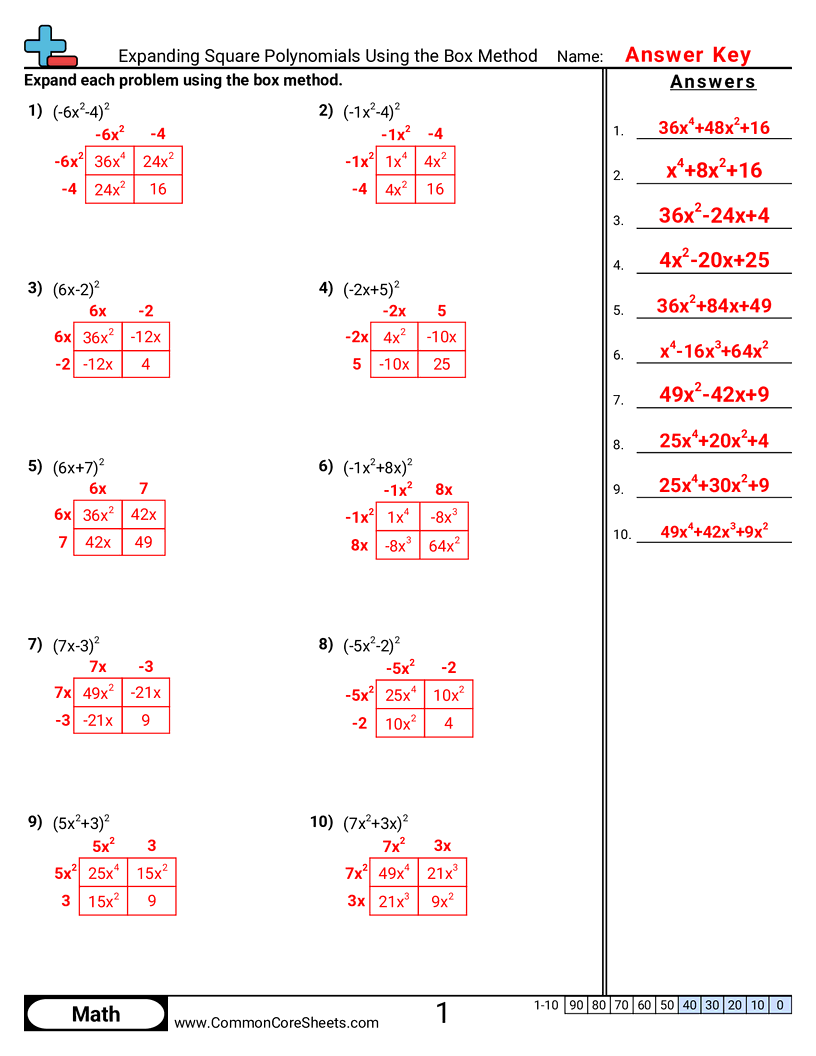
- Use a box (grid) to multiply a binomial by itself, like (x + 5)(x + 5).
- Combine like terms from the grid to write the final expanded quadratic expression.
- Connect the box method to the distributive property so you can see where each term in the answer comes from.
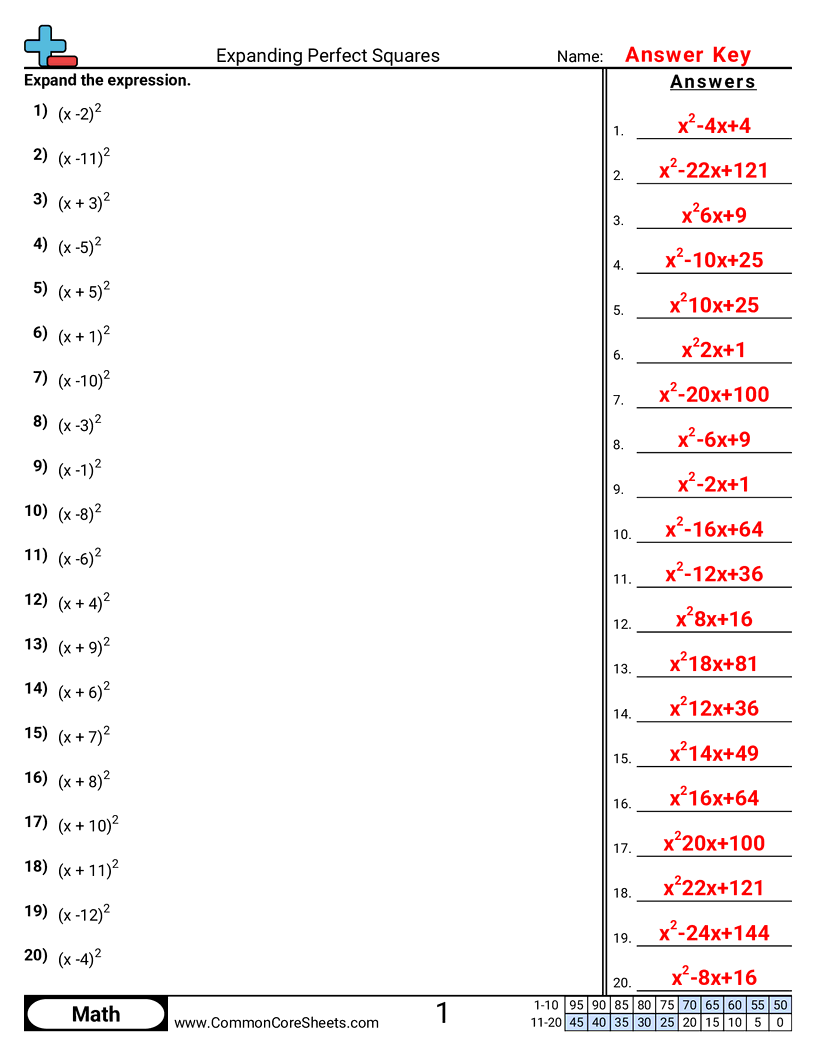
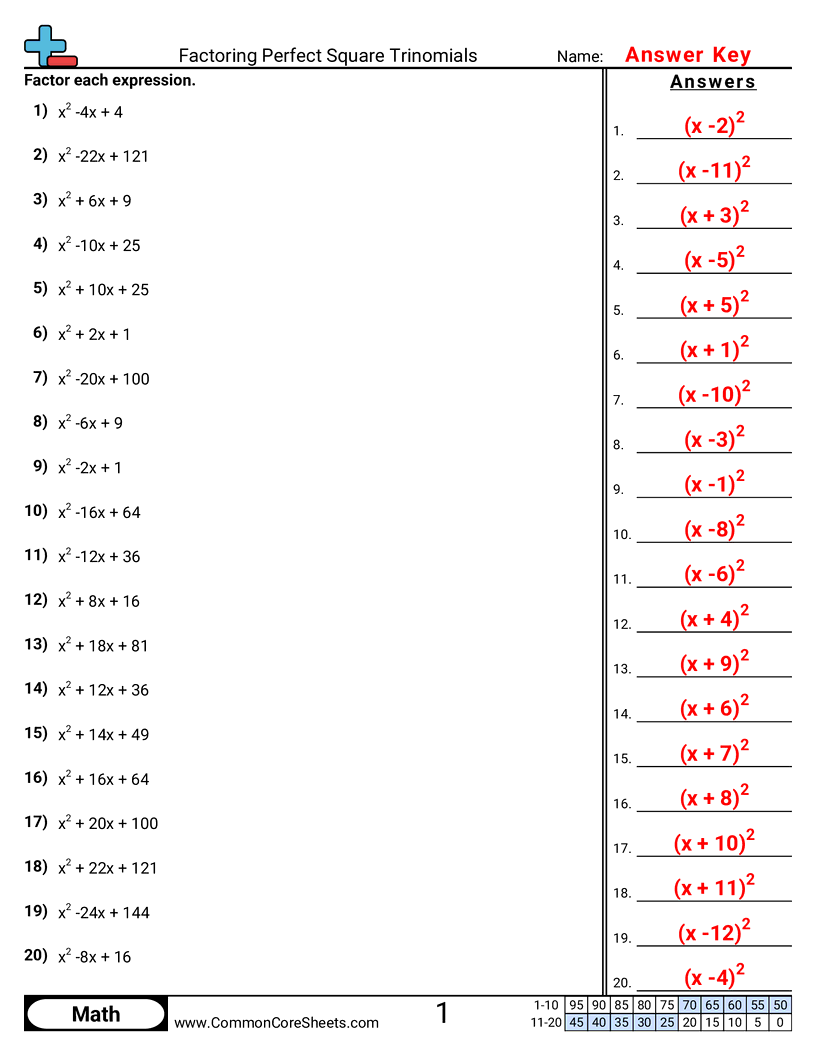
- Practice expanding squared binomials like (x + 5)^2 into a trinomial.
- Use the perfect square patterns (a + b)^2 and (a - b)^2 to expand quickly without doing full FOIL every time.
- Recognize when a trinomial matches the pattern of a perfect square.
- Factor perfect square trinomials into a squared binomial like (a+b)^2 or (a-b)^2.
- Use the middle term to decide whether the binomial uses addition or subtraction.
About these worksheets
These worksheets bring together coordinate geometry and algebraic reasoning. Students use similar triangles to find missing coordinates and rise values, rotate shapes around the origin, and identify points of intersection by solving systems of equations. Aligned with eighth grade standards, these activities strengthen graphing skills and spatial reasoning on the coordinate plane.
8ee8a
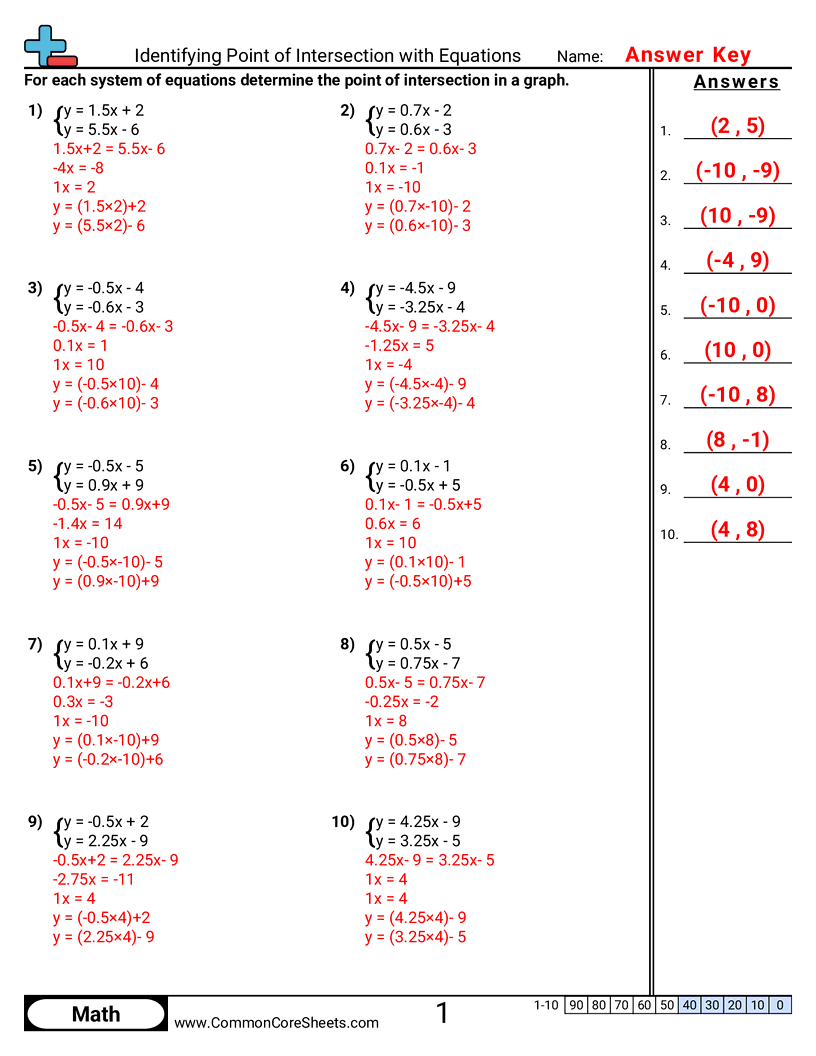
- Find the exact point where two lines cross by solving both equations together.
- Use substitution to plug one equation into the other and solve for x and y.
- Use elimination to combine equations and solve for the ordered pair.
- Check your solution by plugging the x and y values back into both equations.
About these worksheets
These worksheets explore number concepts essential for middle school math, including square roots, cube roots, rational and irrational numbers, laws of exponents, scientific notation, radicals, and powers of ten. Students practice estimating radical values, simplifying expressions with exponents, and performing operations in scientific notation. Aligned with eighth grade Common Core standards, these resources build a strong number sense foundation for high school math.
8ee1
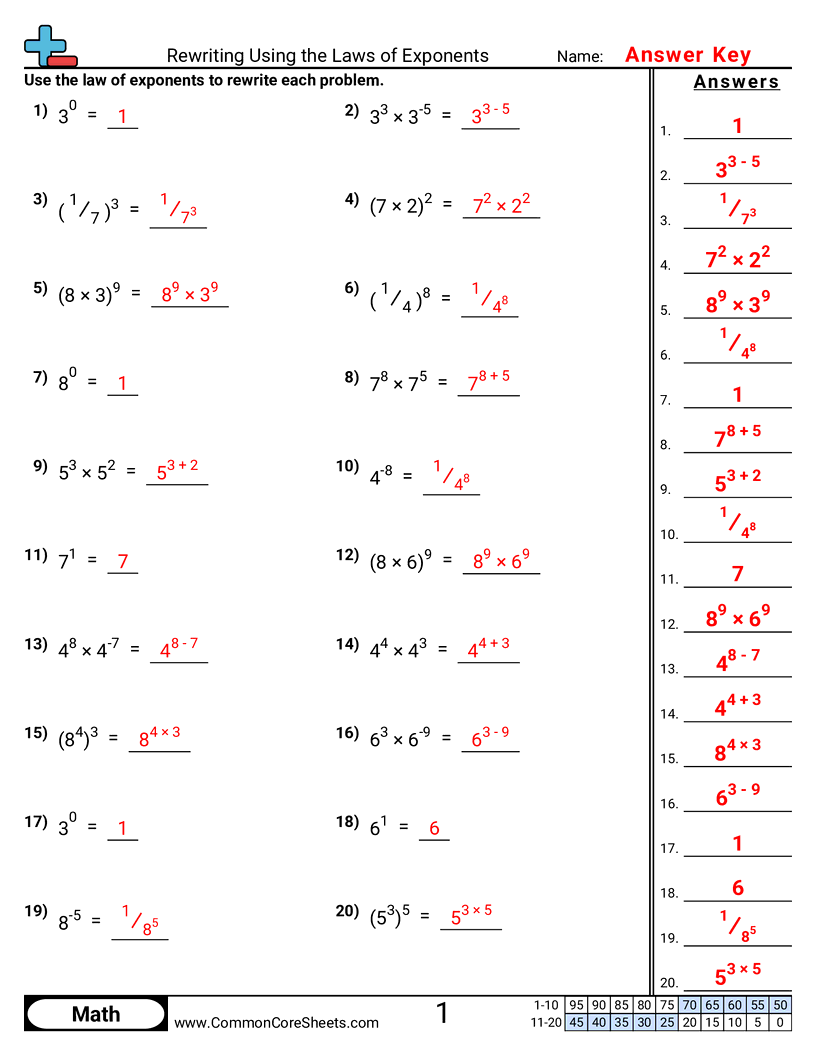
- Rewrite expressions with exponents using the product and quotient rules.
- Simplify powers raised to powers by multiplying exponents.
- Rewrite expressions with zero and negative exponents using reciprocals.
8ee1
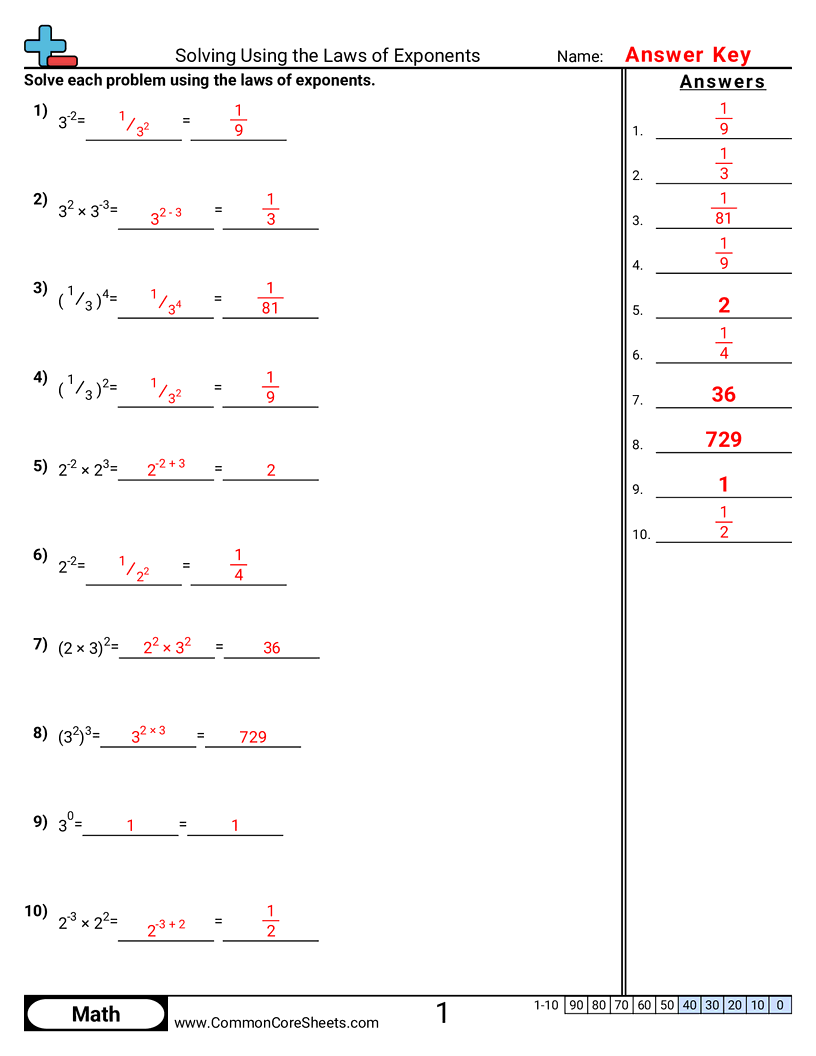
- Practice rewriting negative exponents as fractions (e.g., 3⁻² becomes 1/3²)
- Multiply powers with the same base by adding their exponents, even when some exponents are negative
- Raise fractions to a power by applying the exponent to both the numerator and denominator
- Simplify expressions step by step to reach a final whole number or fraction
8ee2
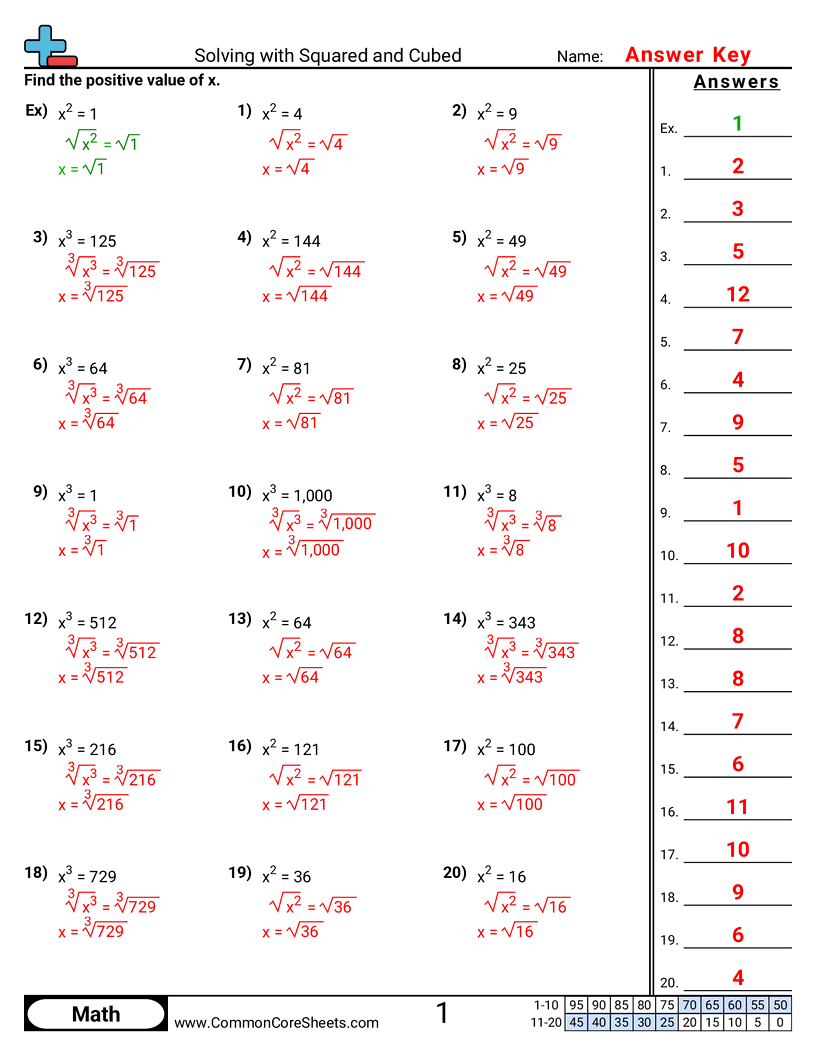
- Evaluate expressions with squared and cubed numbers.
- Solve simple equations where a number is squared or cubed to find the missing value.
- Recognize perfect squares and perfect cubes and match them to their roots.
8ns2
- Rewrite negative exponents as reciprocals so the exponent becomes positive.
- Evaluate expressions with negative powers to get the correct fraction or decimal value.
- Work with negative exponents on whole-number bases, fractions, and powers of 10.
8ns2
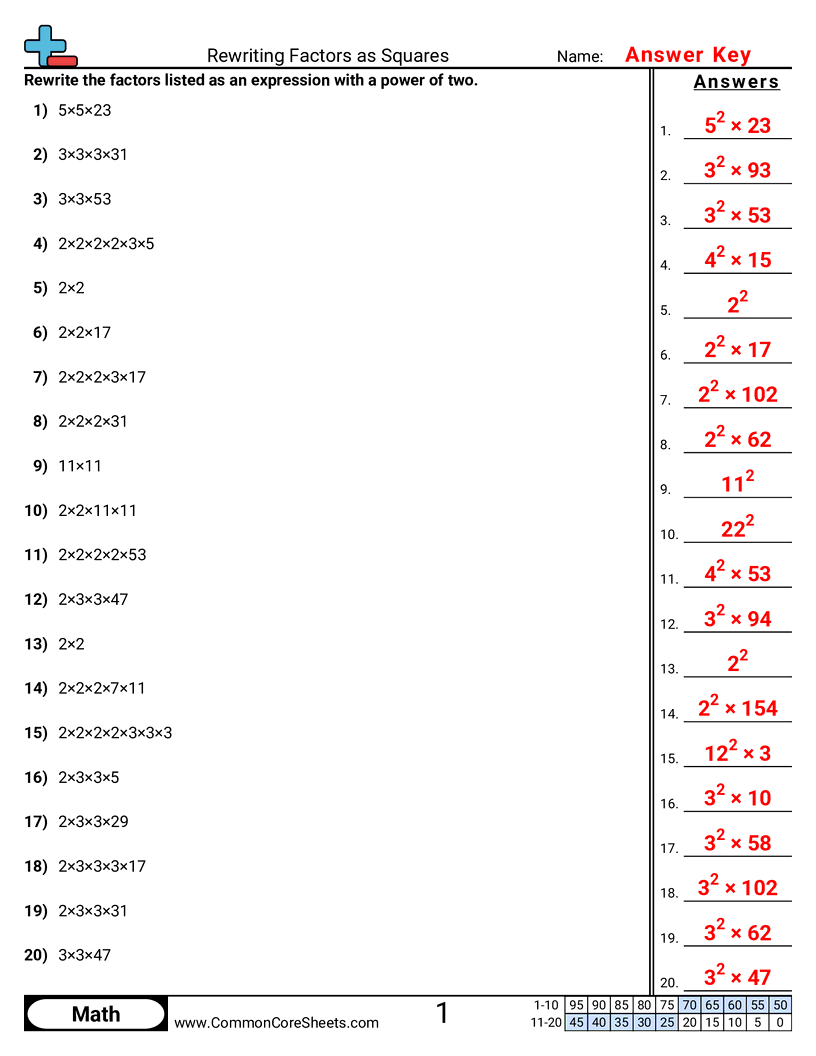
- Break a number into factors and spot pairs that make a perfect square.
- Use exponents to write repeated factors more simply, like 3×3 as 3^2.
8ee4
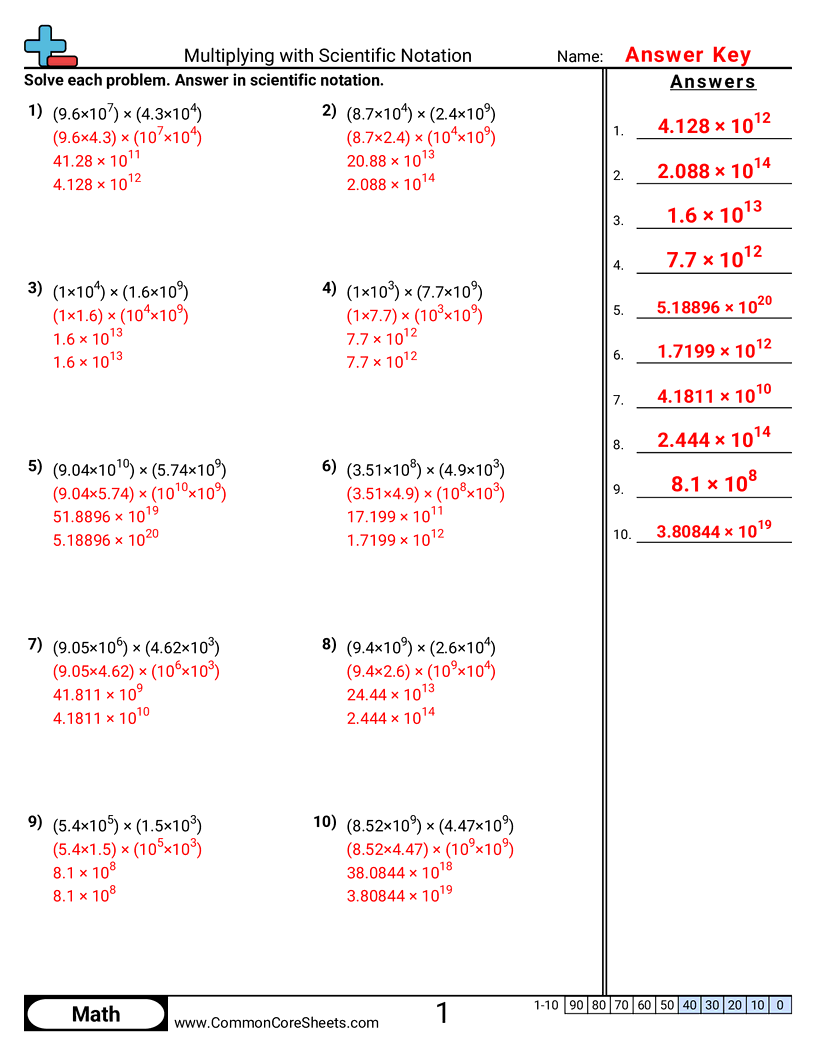
- Multiply two numbers written in scientific notation.
- Multiply the coefficients and combine the powers of 10 using exponent rules.
- Rewrite answers in proper scientific notation by shifting the decimal and adjusting the exponent.
8ee2
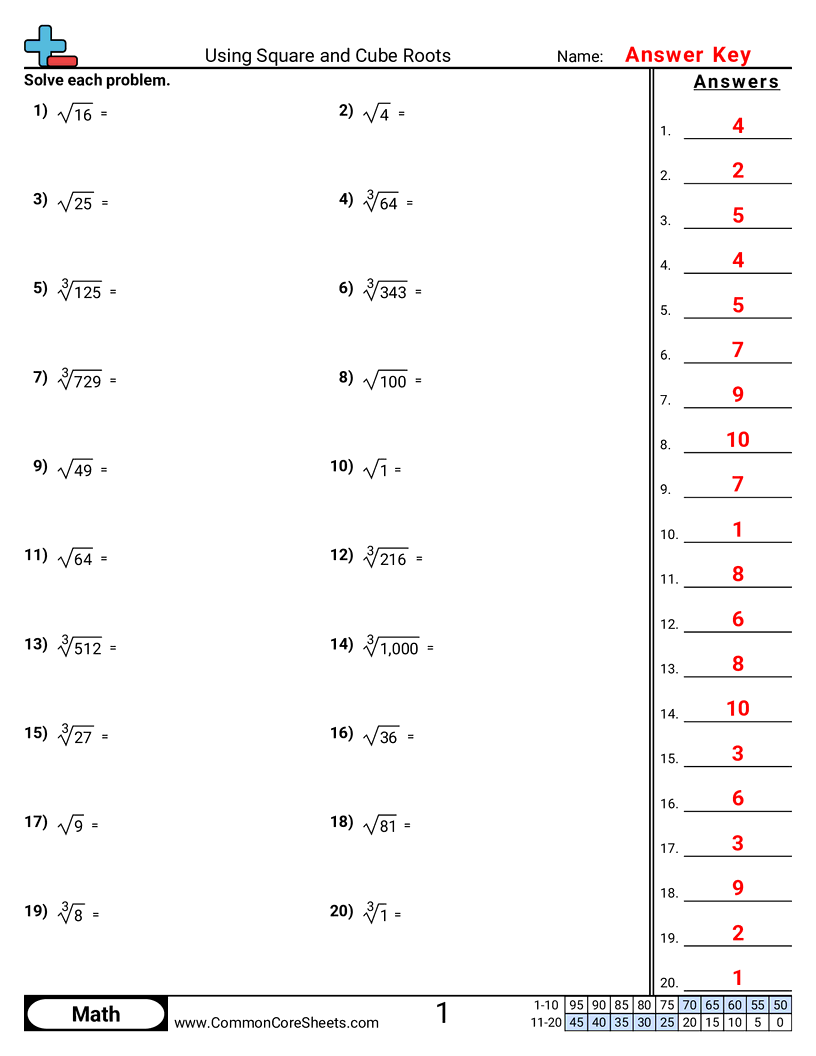
- Find the square root of a perfect square and write the whole-number answer.
- Find the cube root of a perfect cube and write the whole-number answer.
- Recognize when a number is a perfect square or a perfect cube.
8ns2
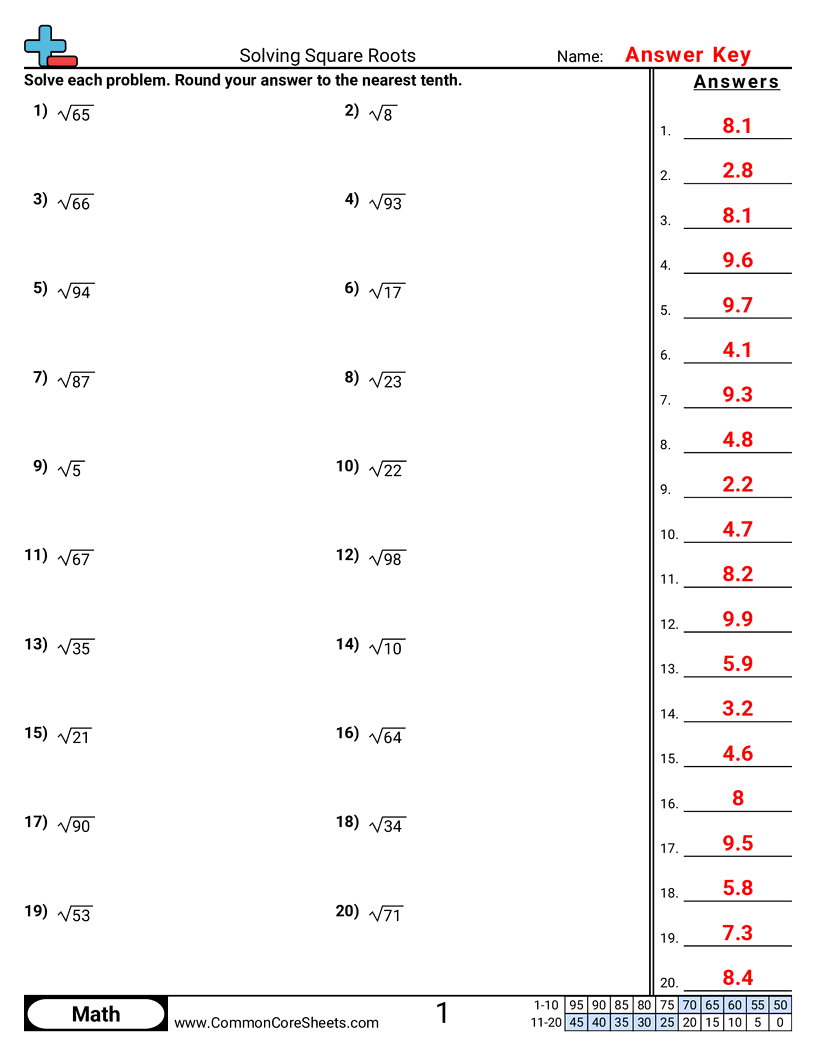
- Practice estimating square roots of numbers that aren't perfect squares
- Figure out which two whole numbers a square root falls between
- Work with square roots of various sizes to build number sense around irrational numbers
8f3
- Decide whether an equation makes a straight-line relationship (a linear function) or not.
- Recognize common linear forms like y = mx + b, point-slope form, and standard form.
- Spot equations that are not linear because they have exponents, roots, variables multiplied together, or variables in the denominator.